


Enterprise AI keeps stalling at the last mile. Forward Deployed Engineering is emerging as an answer to that problem – and increasingly looks like a new operating model, not just a hiring fad. This market insight brings together market research on AI deployment, talent and managed services to assess what the shift could mean for enterprise technology providers.
WHY BIG TECH IS BETTING BILLIONS ON FDEs?
Forward Deployed Engineering (FDE) has gone from a Palantir curiosity to a category that Amazon, Microsoft, OpenAI and Anthropic are all building around – inside the same twelve months.
- AWS committed $1 billion in June 2026to embed thousands of engineers directly inside customer teams to build and ship AI systems in days rather than months. 1
- Days later, Microsoft launched Frontier Company, a $2.5 billion business built around roughly 6,000 experts co-designing, deploying and continuously improving AI systems inside client organizations. 2
- OpenAI went further still, spinning up a $4 billion subsidiary – the OpenAI Deployment Company – built entirely around forward deployed engineers, and seeded it on day one by acquiring a 150-person deployment consultancy. 3
- Anthropic backed a roughly $1.5 billion joint venture, together with Blackstone, Hellman & Friedman and Goldman Sachs, explicitly designed to widen access to forward deployed engineers for mid-market companies. 4
That is four of the industry’s most capitalized players converging on the same operating model, inside the same quarter – roughly $9 billion of committed capital around a job title that barely existed three years ago. That convergence is the signal worth sitting with, more than any single headline number.
WHY ENTERPRISE AI NEEDS A NEW DELIVERY MODEL
The AI paradox: AI capability is accelerating. Enterprise absorption is not keeping pace

The issue is increasingly not access to AI; it is turning AI into operational change. OpenAI CEO Sam Altman has acknowledged that businesses and the broader economy have adapted to AI more slowly than he originally expected. These market insights do not necessarily weaken the AI-services opportunity. They strengthen the case for a services layer that sits between frontier AI capability and enterprise adoption. That is where forward-deployed engineering enters the picture.
WHAT AN FDE ACTUALLY DOES INSIDE THE CUSTOMER ENVIRONMENT
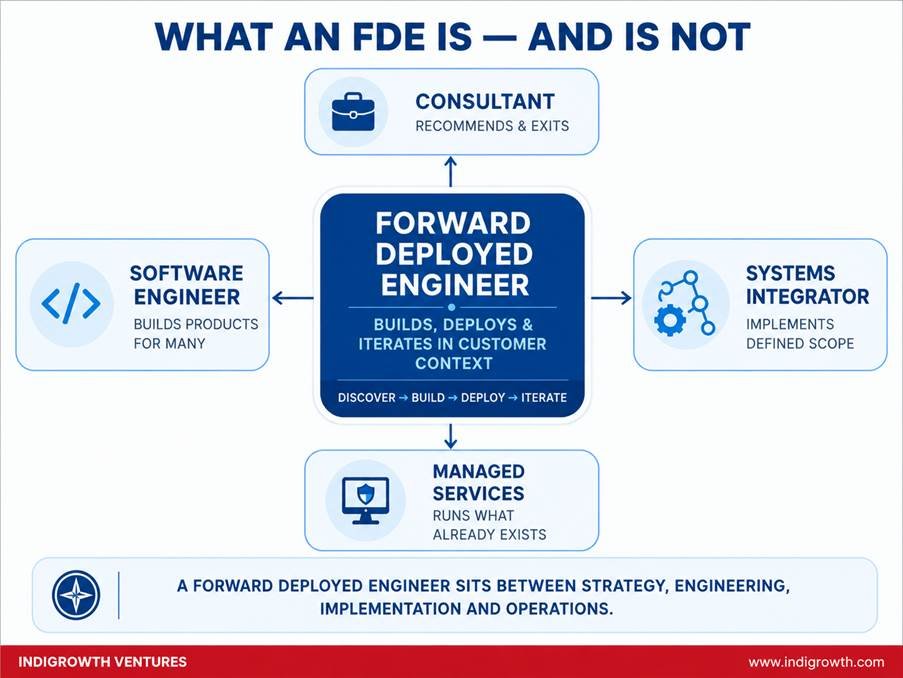
An FDE is an engineer who embeds inside a customer’s environment to scope, build and stay accountable for a working system – not a slide deck, a demo, or a plan someone else has to execute. Palantir pioneered the role in its early years after finding that complex intelligence and defense deployments could not simply be sold off the shelf; engineers had to work alongside customers inside their operating reality. For roughly its first decade, Palantir employed more forward-deployed engineers than product engineers.5
The model is easiest to understand by what it deliberately is not – not a consultant, not a traditional software engineer, not a systems integrator, not a managed-services team. Instead, it sits between these roles, combining elements of strategy, engineering, implementation and ongoing iteration. (see the image below).
WHERE FDEs CLOSE THE ENTERPRISE AI LAST-MILE GAP
AI has created an unusual enterprise technology problem. The demo is easy. The transformation is hard. Generative and agentic AI break the assumption that made managed services scalable in the first place: that most customer environments are similar enough to serve from one shared playbook. They are not. A model’s behavior in production is shaped by the customer’s own data, workflows, permissions and edge cases – not simply by a settings menu a remote support engineer can configure. MIT Project NANDA, analyzing 300+ enterprise GenAI initiatives, reported that 95% showed no measurable P&L impact.6 The more useful insight is not that the models failed, but that enterprise value depends on workflow fit, learning, integration and adoption – the last-mile work that an embedded engineering model is designed to address.
That is exactly the gap an FDE is built to close, across four fronts a standard managed-services engagement isn’t structured to touch:
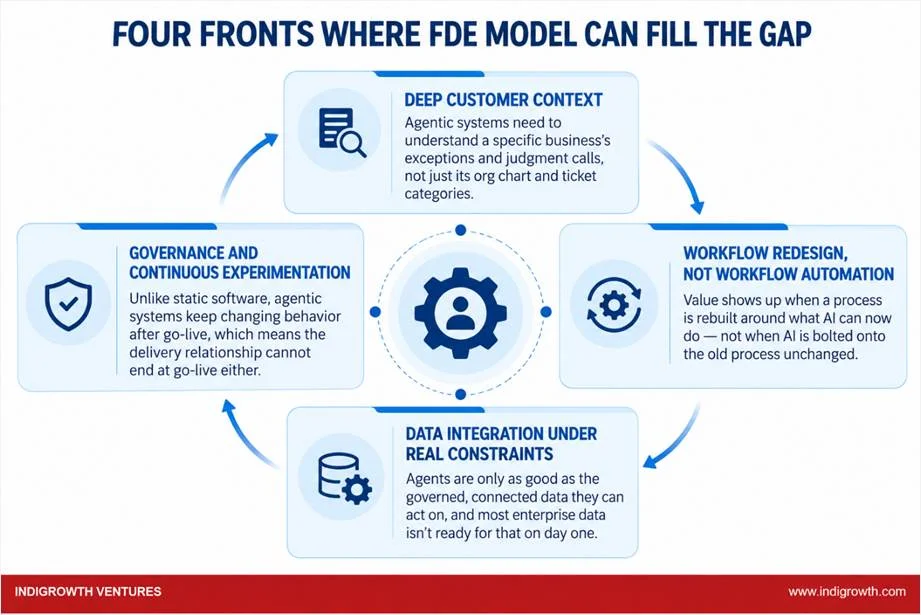
None of this fits a fixed-scope, standardized-delivery model. A traditional plan assumes the system’s behavior is known before rollout, so risk is managed with a checklist. An agentic system’s behavior is still being discovered after rollout, so governance has to be continuous – staged permissions, human review on the highest-risk actions, a feedback loop back into the build. That is a build-and-operate posture, and it fits an embedded engineer who keeps iterating far better than a delivery team that closes the project and moves on.
IS THIS REAL SHIFT OR AI-HYPE?
Both can be true at once, and holding that tension is the point. The growth signals are real and fast:
- FDE hiring demand is accelerating: Uplers’ 2026 market review reports that FDE job postings were up roughly 729% year over year by April 2026, reflecting the shift from AI demos toward production deployment.10
- Christian & Timbers estimates roughly 17,000 FDEs currently work in the US, though only about 2,000 reportedly combine the sector depth and applied-AI fluency the role demands; at the start of 2026 only 5-10% of companies planned to hire FDEs, and by mid-year that had jumped to 70%. 7
But this remains largely a talent and capital story, not yet a sized market of its own. Market research on managed services puts the global market at about $460.6 billion in 2026, rising to $705.2 billion by 2031 at an 8.9% CAGR.8 There is no equivalent third-party FDE market figure yet because much of the forward-deployed capacity still sits inside AI labs, hyperscalers and technology-services firms rather than a standalone services category.
That gap matters given what OpenAI’s own CEO said days before this article was written. Sam Altman acknowledged that he and other AI believers were likely too optimistic about how fast AI would go mainstream, comparing today’s adoption curve to customers still renting from Blockbuster in Netflix’s early years. His point wasn’t that AI capability is overstated – it’s that changing how organizations work takes longer than the technology’s pace suggests. That is precisely the gap FDEs exist to close. Whether the model becomes a durable, independently priced category, or stays a temporary surge inside a handful of labs, is the open question every buyer, GSI and MSP should be sitting with.9
THE MANAGED SERVICES BUYING CONVERSATION IS CHANGING
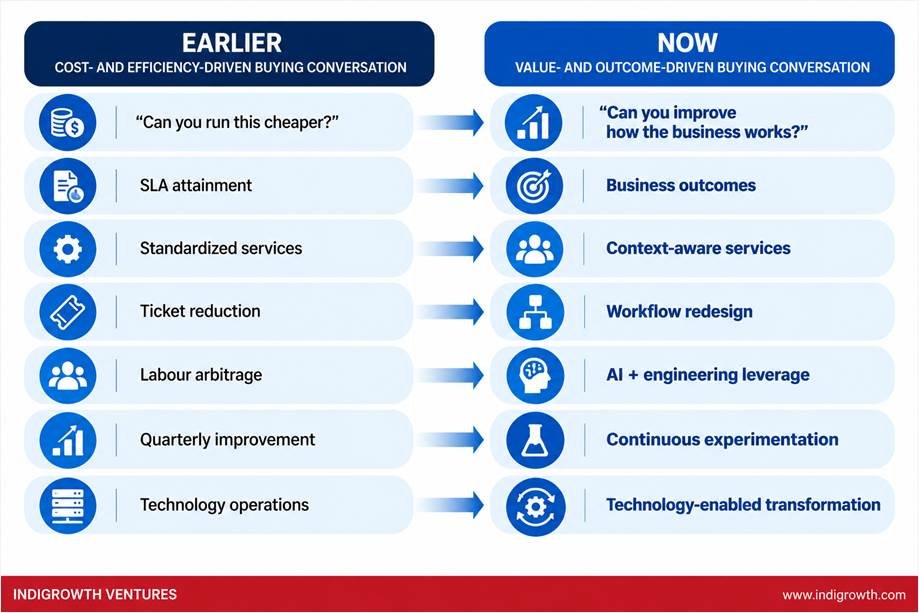
Managed services were built to make IT boring, predictable and cheap – three things AI-era enterprises no longer prize above everything else. For two decades the pitch was consistent: outsource commodity infrastructure, hit contracted uptime, cut headcount cost, standardize delivery across as many clients as possible to protect provider margin. Standardization was the entire point – the same runbook, the same tooling, the same tiered support desk, applied at scale.
That model still works well for infrastructure, network and security operations. The broader managed services market is forecast to grow from about $460.6 billion in 2026 to $705.2 billion by 2031, an 8.9% CAGR.
But the buying conversation has now changed:
WHERE FDEs CREATE VALUE – AND WHERE THEY DO NOT
FDE is not a universal replacement for managed services. It is a different tool for a different stage of the customer relationship. The opportunity is genuine where nobody has yet worked out what the redesigned workflow should look like, and getting it wrong is expensive. The limitation is just as genuine where the problem is already solved and the only remaining question is how cheaply it can be run at scale.
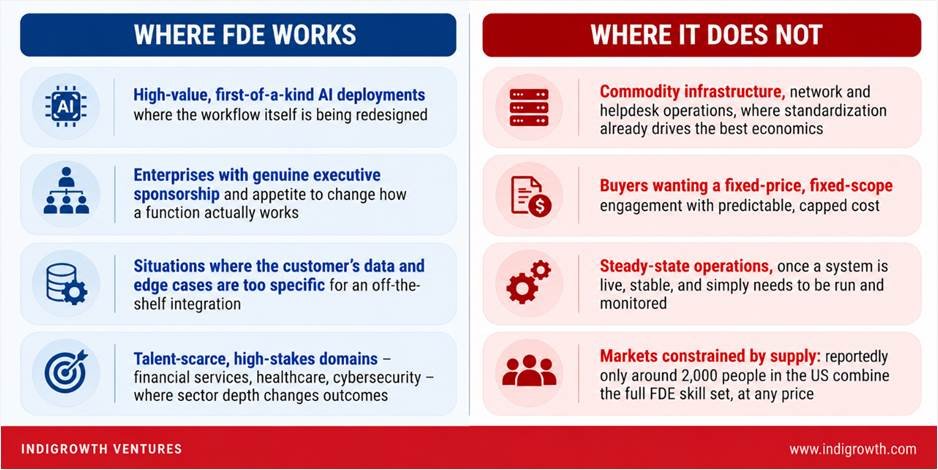
The limitation that matters most is supply, not appetite. If demand for FDEs is genuinely growing ten-fold at the largest services firms, as Christian & Timbers reports, while the qualified talent pool grows only linearly, the model cannot scale the way managed services scaled – by hiring junior staff against a repeatable playbook.
Compensation is another signal of how scarce the profile has become. Uplers’ 2026 guide places total compensation at roughly $300,000-$450,000 for mid-level FDEs, $450,000-$550,000 for senior FDEs and $600,000+ for staff/principal roles.10 Those are specialist-engineering economics, and they constrain how quickly any provider can build a large FDE bench.
WHAT THE FDE SHIFT MEANS FOR MSPs AND GSIs
The FDE model reads less like a threat to the existing managed-services book of business and more like a signal of where the next layer of margin may be moving. The steady-state, standardized-delivery core – infrastructure, network and security operations – remains central to a managed services market valued at about $460.6 billion in 2026 and forecast to grow at an 8.9% CAGR through 2031.
What is changing is that the high-value work above that layer – first-of-a-kind AI transformation, workflow redesign, agentic deployment – increasingly demands embedded, outcome-owning engineering capability most MSPs and mid-tier GSIs don’t yet have at scale, which is exactly why hyperscalers and AI labs are building or buying it directly rather than waiting for the channel to catch up.
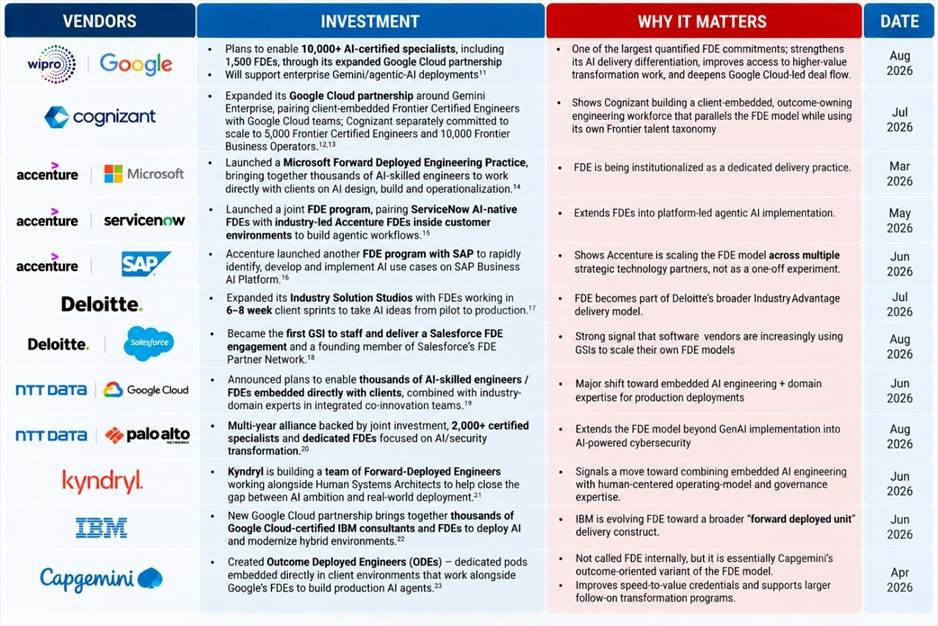
WHAT COMES NEXT: THE FORWARD DEPLOYED MSP?
The winners of the next decade of enterprise AI delivery will not choose between managed services and forward deployed engineering. They will fuse the two – FDEs to build and prove what works inside a customer’s environment, and managed-services discipline to run it reliably at scale once it does. The market insights in this article point toward that handoff as an emerging operating-model opportunity: embedded enough to earn the transformation, disciplined enough to keep running it. Call it the Forward Deployed MSP.
Understand Issues. Remove Guesswork. Embed Insights.
- AWS invests $1 billion to embed AI forward deployed engineers with customers, AWS / Amazon, 30 June 2026;
https://www.aboutamazon.com/news/aws/aws-1-billion-forward-deployed-ai-engineers - Microsoft Frontier Company: AI engineering that amplifies and protects your intelligence, Microsoft, 2 July 2026;
https://blogs.microsoft.com/blog/2026/07/02/microsoft-frontier-company-ai-engineering-that-amplifies-and-protects-your-intelligence/ - OpenAI launches the OpenAI Deployment Company to help businesses build around intelligence, OpenAI, 11 May 2026;
https://openai.com/index/openai-launches-the-deployment-company/ - Anthropic, Blackstone bet the next trillion-dollar AI business is implementation, not just models, TechCrunch, 15 July 2026;
https://techcrunch.com/2026/07/15/anthropic-blackstone-bet-the-next-trillion-dollar-ai-business-is-implementation-not-models/ - What Is a Forward-Deployed Engineer? Definition, Origin & Model, Plank, 2026;
https://joinplank.com/forward-deployed-engineer - The GenAI Divide: State of AI in Business 2025, MIT Project NANDA / MLQ, July 2025;
https://mlq.ai/media/quarterly_decks/v0.1_State_of_AI_in_Business_2025_Report.pdf - Forward-deployed engineers are the AI industry’s latest talent obsession, TechCrunch, 30 July 2026;
https://techcrunch.com/2026/07/30/forward-deployed-engineers-are-the-ai-industrys-latest-talent-obsession/ - Managed Services Market worth $705.22 billion by 2031, MarketsandMarkets, June 2026;
https://www.marketsandmarkets.com/PressReleases/managed-services.asp - Sam Altman Admits It’s Going to Take a Long Time Before AI Goes Mainstream, Gizmodo, 24 August 2026;
https://gizmodo.com/sam-altman-admits-its-going-to-take-a-long-time-before-ai-goes-mainstream-2000802418 - Forward Deployed Engineer: The Complete 2026 Report – Origin, Demand, Roles, Salary & More, Uplers, 30 June 2026;
https://www.uplers.com/article/forward-deployed-engineer-guide/ - Wipro and Google Cloud Expand Partnership to Scale AI into Core Enterprise Operations, Wipro, 27 August 2026;
https://www.wipro.com/newsroom/press-releases/2026/wipro-and-google-cloud-expand-partnership-to-scale-ai-into-core-enterprise-operations/ - Cognizant expands partnership with Google Cloud to accelerate enterprise AI adoption with Gemini Enterprise and Google Workspace, Cognizant, 7 July 2026;
https://news.cognizant.com/2026-07-07-Cognizant-expands-partnership-with-Google-Cloud-to-accelerate-enterprise-AI-adoption-with-Gemini-Enterprise-and-Google-Workspace - Cognizant Reports Second Quarter 2026 Results, Cognizant, 29 July 2026;
https://news.cognizant.com/2026-07-29-Cognizant-Reports-Second-Quarter-2026-Results - Accenture Launches Microsoft Forward Deployed Engineering Practice to Help Organizations Scale AI Across the Enterprise, Accenture, 18 March 2026;
https://newsroom.accenture.com/news/2026/accenture-launches-microsoft-forward-deployed-engineering-practice-to-help-organizations-scale-ai-across-the-enterprise - ServiceNow and Accenture Launch Forward Deployed Engineering Program to Scale Agentic AI Across the Enterprise, Accenture / ServiceNow, 6 May 2026;
https://newsroom.accenture.com/news/2026/servicenow-and-accenture-launch-forward-deployed-engineering-program-to-scale-agentic-ai-across-the-enterprise - Accenture Launches Forward Deployed Engineering Program with SAP, Accenture, 8 June 2026;
https://newsroom.accenture.com/blogs/2026/accenture-launches-forward-deployed-engineering-program-with-sap - Deloitte Drives Agentic Industry Transformation at the Speed of AI with Expanded Industry Solution Studios and Forward Deployed Engineers, Deloitte, 22 July 2026;
https://www.deloitte.com/us/en/about/press-room/deloitte-drives-agentic-industry-transformation.html - Deloitte Becomes First Global System Integrator to Deliver a Salesforce Forward Deployed Engineering Engagement, Deloitte, 12 August 2026;
https://www.deloitte.com/us/en/about/press-room/deloitte-becomes-first-gsi-to-deliver-salesforce-fde-engagement.html - NTT DATA Expands Collaboration with Google Cloud to Accelerate Enterprise AI from Pilots to Production, NTT DATA, 9 June 2026;
https://www.nttdata.com/global/en/news/press-release/2026/june/060900 - NTT DATA and Palo Alto Networks Sign Global Strategic Alliance to Accelerate Secure AI Transformation, NTT DATA, 20 August 2026;
https://www.nttdata.com/global/en/news/press-release/2026/august/082001 - Kyndryl celebrates Pride with Purpose – Building more inclusive AI, Kyndryl, 30 June 2026;
https://www.kyndryl.com/us/en/about-us/news/2026/06/kyndryl-celebrates-pride-month - IBM and Google Cloud Announce Strategic Partnership to Scale AI with Human Expertise and AI-Powered Delivery, IBM, 4 June 2026;
https://newsroom.ibm.com/2026-06-04-ibm-and-google-cloud-announce-strategic-partnership-to-scale-ai-with-human-expertise-and-ai-powered-delivery - Capgemini unveils Google Cloud AI Enterprise Hub to accelerate agentic AI enterprise transformation, Capgemini, 23 April 2026;
https://www.capgemini.com/gb-en/news/press-releases/capgemini-unveils-google-cloud-ai-enterprise-hub-to-accelerate-agentic-ai-enterprise-transformation/

