

 2
2
The global influencer marketing industry has grown from $1.7 billion in 2015 to $33 billion in 2025 — a 20x expansion in a decade. Behind that number is a structural shift in how products break through, how consumer trust is built, and who actually controls the narrative. This piece examines what that shift looks like in practice and what it means for strategy.
From scroll to sell-out: How influencer marketing is rewriting product success
A single 30-second TikTok, shot in a car, in Dubai, by a food enthusiast who wasn’t even paid – turned a small chocolatier into a global phenomenon, sparked an actual pistachio shortage, and gave the world a new marketing template. That’s not luck. That’s the new product launch playbook, and it deserves a close look.
The Dubai Chocolate Phenomenon: A Masterclass in Modern Marketing
In late 2023, UAE food influencer Maria Vehera sat in her car, broke open a bar of chocolate, and let the camera catch what happened next: the audible crunch of toasted knafeh through smooth pistachio cream, shot in perfect ASMR. The video went on to cross 130 million views. The bar – “Can’t Get Knafeh of It”, from a tiny Dubai-based chocolatier called FIX Dessert Chocolatier, started as a side hustle by Sarah Hamouda, a British-Egyptian engineer who said the product was born from a pregnancy craving. By Feb 2024, the bars – 200 grams, priced at USD 20 each – were selling out within minutes, capped at 500 orders a day via Deliveroo. By early 2025, #DubaiChocolate had accumulated 13.8 billion TikTok views in a single quarter¹, the product had attracted a 300% increase in international sales within a year², triggered a global pistachio shortage, and pushed the category from one new product launch in 2024 to 51 by 2025³ – with everyone from Lindt to Trader Joe’s racing to put their own version on shelf. From a single unsponsored TikTok video.
That’s not an anomaly. That’s a case study in what influencer marketing has become, and one that market insights helps demystify.
The Marketing Toolkit Has Changed – Influencer Marketing Has Moved from Amplification to Demand Creation
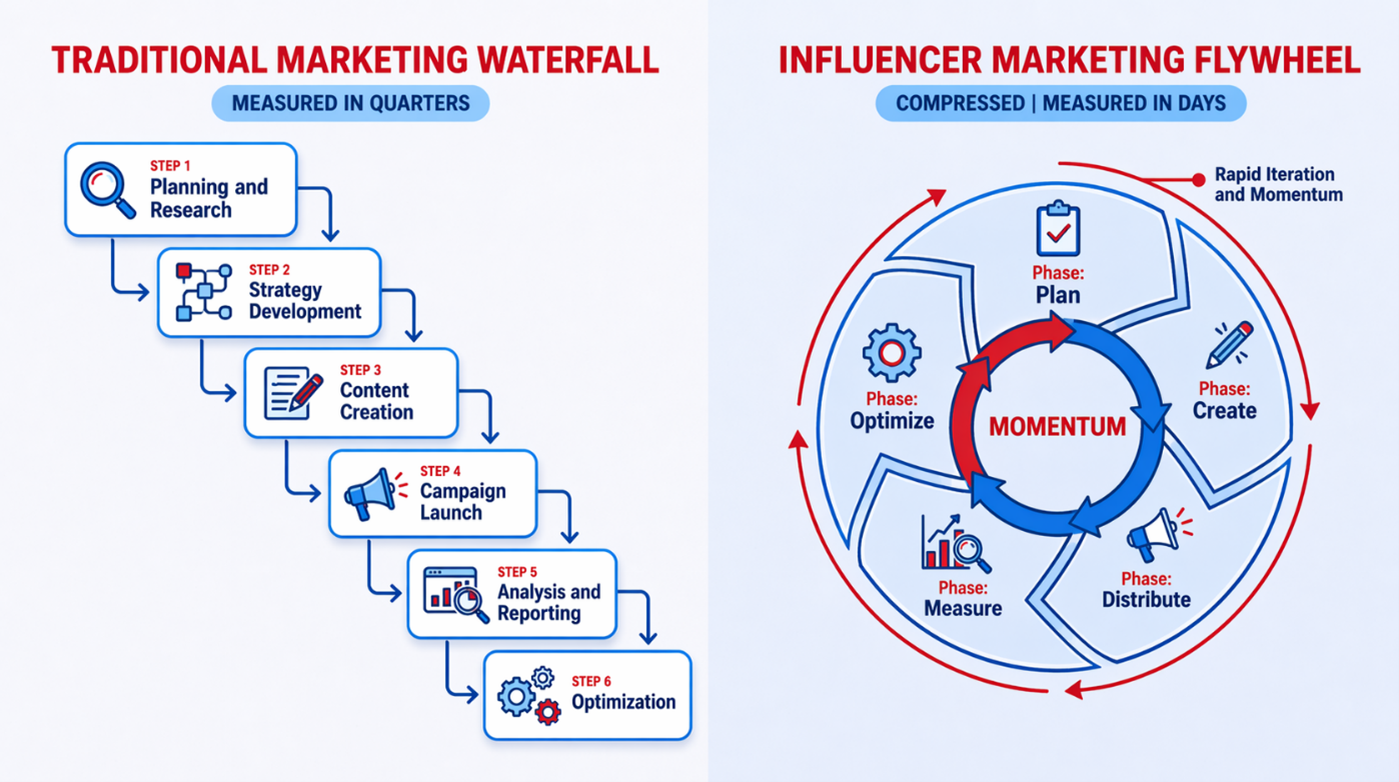
Traditional product marketing had a familiar structure: develop, test, list, advertise, distribute. The process was deliberate, linear, expensive, and often slow via traditional channels – TV commercials, print, PR, and trade marketing. The assumption was that the brand builds the narrative and pushes it to the consumer.
Social media flipped the pattern: Social platforms are no longer merely communication channels; they are now discovery engines, validation engines, and increasingly transaction engines. Deloitte’s 2025 study found that 61% of consumers discovered a new brand or product on social media in the past 12 months, while 72% said they are willing to buy directly within social platforms. Just as important, 83% of consumers say the creators they follow are trusted sources of information⁴. In other words, creators are collapsing the distance between awareness, trust, and trial.
Shifting marketing budgets: The global influencer marketing industry reached an estimated USD 33bn in 2025, up from just USD 1.7bn in 2015 – nearly a 20x expansion in a decade⁵. That pace of growth is not a trend; it’s a structural shift in how marketing budgets find their way to consumer attention. For context, US brands alone are expected to spend over USD 13bn on influencer marketing by 2027, up from USD 10.5bn in 2025⁶. Influencers are no longer a bolt-on to the media plan. For many product categories, they are the media plan. Companies are turning to market research firms to decode these shifts and competitive activity.
TikTok in particular has altered the economics of product discovery – TikTok Shop reached USD 15.82bn in US sales in 2025 and now accounts for 18.2% of total US social commerce⁷. This is not just a media story; it is a commerce infrastructure story. When discovery, social proof, and checkout sit inside one ecosystem, the distance between “I saw this” and “I bought this” becomes materially shorter.
Speed to market is the new competitive advantage. When a trend explodes, there’s no time for traditional development cycles. Agile supply chains and rapid prototyping separate winners from watchers.
The buyer journey has inverted. It used to be Awareness → Interest → Desire → Action. Now it’s Discovery (via algorithm) → FOMO (via scarcity) → UGC (social proof) → Purchase. The product creates the awareness, not the other way around.
What This Does to the Product Lifecycle
Viral products don’t just happen. They follow a predictable pattern that savvy marketers can anticipate and optimize for:
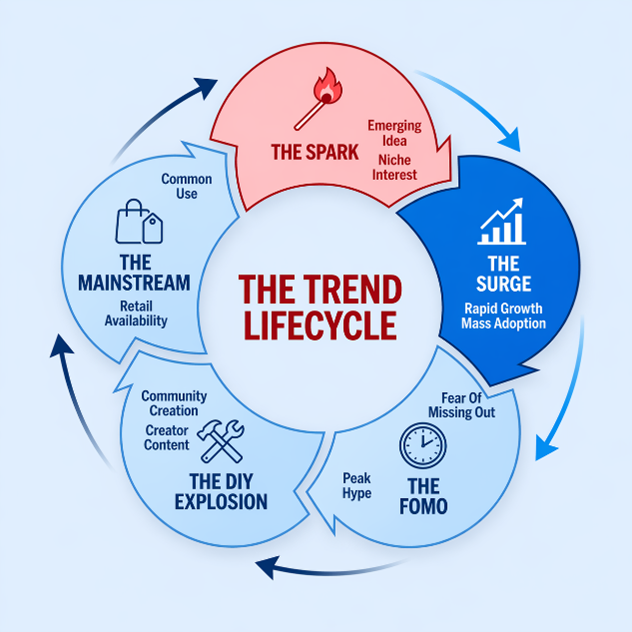
Phase 1: The Spark. A creator discovers the product organically. This is where product design matters most. If there’s no “TikTok-able” moment, there’s no spark.
Phase 2: The Surge. The algorithm picks up the content and amplifies it. TikTok maintains its position as the most engaging major social media platform, with an average median engagement rate of 8.0%, as of Apr 2026⁸. Small creators often drive bigger surges.
Phase 3: The FOMO. Scarcity kicks in. When supply can’t meet demand, desire intensifies. Content becomes a proxy for ownership. People share what they can’t have.
Phase 4: The DIY Explosion. Users create their own versions. This is where the trend becomes a movement. The product is no longer just a product. It’s a template.
Phase 5: The Mainstream. Retailers and competitors enter. The trend goes from niche to mass market.
Labubu is another textbook case: Labubu, a designer plush toy first created in 2015 by Pop Mart, sat in relative niche obscurity for nearly a decade. Then in April 2024, K-pop superstar Lisa from BLACKPINK casually posted an unboxing on her Instagram story. Labubu went global within weeks. By mid-2025, a single giant Labubu doll sold at a Beijing auction for USD 172,800, and the hashtag had crossed 1.4m TikTok videos⁹.
Stanley’s insulated tumblers followed a similar arc – a product that had been around for over a century, suddenly reborn as a cultural symbol when lifestyle creators made it a cornerstone of the “that girl” aesthetic that swept TikTok through 2022 and 2023. Brands looking to replicate this success need insights into which product attributes resonate on specific platforms.
The pattern holds across categories and price points. Here are ten products from different sectors that followed the same five-phase lifecycle: a creator spark, an algorithm surge, FOMO, DIY replication, and mainstream entry:
| Product | Sector | Platform | The trigger moment | Outcome |
|---|---|---|---|---|
| Dubai Chocolate (FIX Dessert Chocolatier) | Food & Beverage | TikTok, Instagram | An unsponsored ASMR video of food influencer Maria Vehera breaking open the bar in her car crossed 130 million views24. The crack of the shell and vivid green pistachio filling were engineered for short-form video. | Global category spawned within 12 months. Social conversations up 1,259% YoY25.New Dubai chocolate products grew from 1 to 51 between 2024 and 2025 (Mintel GNPD)3.300% increase in international sales within a year22. Pistachio shortage triggered globally. |
| Stanley Quencher | Drinkware / Lifestyle | TikTok, Instagram | A women’s shopping blog promoted the near-discontinued tumbler to its female audience. TikTok lifestyle creators then made it the centrepiece of the ‘that girl’ aesthetic. | Revenue grew from $73M (2019) to $750m (2023)26.#StanleyCup crossed 7 billion TikTok views27.A car fire video showing the tumbler still contained ice generated over 20,000 brand mentions in a single day28. |
| Labubu (Pop Mart) | Toys / Collectibles | K-pop superstar Lisa of BLACKPINK posted an unboxing on Instagram in April 2024 — no paid arrangement. Within weeks the plush toy went from decade-long niche obscurity to global demand. | A giant Labubu sold at Beijing auction for $172,8006.Hashtag crossed 1.4 million TikTok videos6.Pop Mart reported record international sales growth. | |
| CeraVe | Skincare / Beauty | TikTok, YouTube | Skincare creator Hyram Yarbro consistently recommended the drugstore brand to millions of Gen Z followers, comparing it favourably to luxury alternatives costing multiples more. | Nationwide ‘CeraVe shortage’ in 2020 as shelves cleared across the US.The brand publicly acknowledged Hyram, locking in viral status sustained for years. |
| Scrub Daddy | Household / Cleaning | TikTok | After a Shark Tank appearance, the brand built a TikTok strategy around product demonstration humour — showing the sponge outperforming competitors in satisfying before-and-after cleaning videos. | Crossed $670 million in cumulative sales29.Became a textbook case in how a commoditised product category can be transformed through creator-native content. |
| Glow Recipe Dew Drops | Premium Skincare | TikTok, Instagram | The Watermelon Glow Niacinamide Dew Drops went viral in 2021 as the shortcut to ‘glass skin’ — a K-beauty aesthetic that resonated strongly with Gen Z beauty creators. | Revenue crossed $300m in 2023, up 88% YoY30.Named Sephora’s top-growing skincare brand and #1 in Earned Media Value on social for two consecutive years30. |
| Dyson Airwrap | Personal Care / Appliances | TikTok, Instagram, YouTube | Sustained creator content showing dramatic before-and-after hair transformations at a $500 price point defied conventional wisdom that high-consideration purchases don’t convert on social. | Dyson’s hair care Amazon revenue surged 210% YoY in H1 202331, driven by the Airwrap.Persistent sell-out conditions from 2021 onwards.Proved influencer marketing has no price-point ceiling. |
| Buldak Carbonara Noodles (Samyang) | Food / FMCG | TikTok | The ‘fire noodle challenge’ drove mass participation. The carbonara variant went viral across Western markets in 2023 as creators shared extreme spice reactions and recipe hacks. | Export revenues grew 65% YoY to 1.34 trillion won ($688m) in 2024, representing 77% of total company sales32.Western retail chains including Walmart and Costco rushed to stock a product previously limited to Asian grocery stores. |
| The Pink Stuff | Household / Cleaning | TikTok (#CleanTok) | A British cleaning paste that had existed for decades became a global phenomenon when TikTok’s #CleanTok community discovered its satisfying before-and-after visual results. | North American demand — a market barely penetrated before — surged to the point of weeks-long stockouts.A zero-marketing-spend product became a global retail must-stock overnight. |
| Ocean Spray Cran-Raspberry | Beverages | TikTok | A man skateboarding to work while drinking Ocean Spray and lip-syncing to Fleetwood Mac’s ‘Dreams’ went viral in October 2020. Ocean Spray had no involvement whatsoever. | Reported sales uplift that week. Ocean Spray’s CEO recreated the video, amplifying goodwill.The purest illustration that a creator with zero brand relationship can move a brand’s commercial needle overnight. |
The implication is not trivial: brands no longer own the timing of their own product’s cultural moment. What was once in the brand’s control – the launch, the narrative, the rollout – can now be triggered by a creator who had no brief, no contract, and no brand relationship at all. The more interesting design question for product teams, then, is: how do you build a product that’s inherently made for the scroll? Leading market intelligence firms are now tracking product design attributes that correlate with viral potential.
Is the Impact Lasting? It Depends on What Kind of Product You Are
This is where the nuance lives, and where most of the hype-versus-reality debate plays out. Viral is not the same as durable.
Dubai Chocolate’s moment lasts because the product fulfills the video’s promise. The sensory experience – visual layers, an ASMR-worthy crack, culturally resonant ingredients – converts viewers into buyers, and buyers into advocates. Even as the original bar remained hard to find outside Dubai, it spawned an entire category. The global market validated a product innovation rooted in a real, distinct consumer experience.
Compare that to the fidget spinner: in just six months in 2017, 19m were sold¹⁸. Within a year, they were landfill. The trend was built on novelty and FOMO, not on a product that solved a meaningful problem or had a story worth repeating. The influencer moment came and went; there was nothing to hold it in place.
Stanley, meanwhile, has shown that a functional product with real utility can sustain its influencer-born momentum – it’s still sold out in certain colorways, years after the initial wave.
The honest answer: influencer marketing can be a powerful ignition mechanism, but it cannot substitute for product-market fit. What it can do – compress the time to awareness and make trial happen at scale – only delivers lasting returns if the product experience earns the advocacy that follows.
Who Should and Shouldn’t Invest in Influencer Marketing
Not every product or category is built for this. The brands that get the most from influencer marketing tend to share a few characteristics:
● Products with visual or sensory distinctiveness. If you can’t demonstrate it in a 15-second video, influencer marketing will be an uphill battle.
● Consumer goods targeting Gen Z and Millennials. These demographics live on social platforms. 86% of consumers have purchased based on influencer recommendations¹⁹.
● Brands with shareable “moments.” Unboxing experiences, texture reveals, before-and-after transformations.
● Companies with agile supply chains. Viral demand without fulfillment capability is a recipe for disaster.
● Businesses targeting niche communities. Nano and micro-influencers deliver 3-4 times higher engagement rates than macro-influencers at a fraction of the cost²⁰.
The picture changes sharply for categories where purchase decisions are rational, committee-driven, and based on specification rather than desire:
● B2B reality: Enterprise software, financial services, and industrial equipment decisions are rational, committee driven, and based on specs and references. Analyst reports and LinkedIn thought leadership carry more weight than a 30 second reaction video.
● Regulated risk: Pharma, financial products, and alcohol face legal and reputational exposure. Misleading claims or undisclosed paid partnerships can trigger enforcement. 64% of consumers distrust influencers who fail to disclose brand relationships and 70% hold negative sentiment toward them after finding out a product was paid for without disclosure²¹. Regulators like the FTC are tightening rules globally.
● Complex products: Enterprise IT, medical devices, and financial instruments require deep explanation, demos, and long evaluation cycles. Influencer formats work best only when desire is emotional, demonstrable quickly, and purchase decisions are fast.
What Can Go Wrong – The Real Pitfalls
The channel’s growth has brought with it a set of failure modes that brands repeatedly encounter.
Chasing reach over relevance. The instinct is to go big – secure the creator with the largest following. But data consistently tells a different story. Micro-influencers (10,000–100,000 followers) deliver significantly higher engagement rates than macro or celebrity accounts²⁰. The Sprout Social 2024 Influencer Marketing Report found that influencer content influences 49% of consumers’ regular purchases – but that trust is most concentrated in creators whom audiences actually feel they know²². Market insights on engagement patterns help brands avoid this common mistake.
Fake engagement and fraud. As budgets have grown, so has the sophistication of engagement manipulation. Inflated follower counts, purchased likes, bot-driven comment activity – these remain a significant operational risk. The 2026 Influencer Marketing Benchmark Report flagged fake engagement and authenticity issues as one of the top two challenges facing marketers²³. Vetting creator authenticity before commitment isn’t optional; it’s foundational.
Treating it as transactional. One-off posts from disconnected creators rarely compound. Long-term partnerships, where the creator has genuinely used the product and has integrated it into their content narrative, build the kind of organic credibility that one-off activations can’t replicate. The Sprout Social data also shows that 71% of influencers offer discounts for longer-term partnerships – there’s a financial case for continuity, not just a creative one²².
Misreading the attribution. Influencer marketing ROI is real – businesses earn an average of USD 5.78 for every dollar spent, with some campaigns generating returns as high as USD 18-USD 20 – but measuring it remains a structural challenge²³. Brands that set up influencer programs without proper attribution mechanisms (unique discount codes, UTM parameters, affiliate tracking) end up defending budget allocations with anecdote rather than data.
Which Platform? The Answer Is Not Obvious
TikTok dominates the cultural conversation around viral product marketing, and the numbers justify its centrality. It is the top product discovery platform for Gen Z, with 60–70% of that cohort discovering brands there rather than through traditional search²⁴. Nano-influencers on TikTok see average engagement rates of 18% – far higher than comparable tiers on other platforms²⁵. Despite the political uncertainty around the platform in the US, half of all marketers say TikTok offers the best ROI among social platforms²⁶.
But it is not the whole answer. Instagram, with 2 billion monthly users and a mature commerce infrastructure through Reels and shoppable posts, remains the platform of choice for 57% of brands running influencer campaigns²⁷. It performs particularly well in fashion, beauty, travel, and aspirational lifestyle categories – anywhere the visual aesthetic carries weight.
For long-form product education, honest review content, and considered purchases, YouTube remains deeply relevant, particularly for mid-tier and macro influencers who build trust over an audience’s weeks and months of engagement.
The practical answer, for most consumer brands, is not a single platform but a layered approach: TikTok for rapid discovery and cultural relevance, Instagram for aesthetics and community building, and YouTube for depth and consideration. The weight of each depends on the target demographic, the product type, and where the brand’s category conversation is most active
The platform choice should also drive the influencer tier chosen. Nano and micro-influencers – those with 1,000 to 100,000 followers – consistently outperform on engagement and conversion relative to their reach, and 73% of brands now prefer working with them over macro and celebrity tiers²⁸. Their audiences feel like peers, not fans, and peer recommendation converts differently than celebrity aspiration.
What This Means for Product Marketers?
The rise of influencer-led product success is not just a marketing trend. It is a broader shift in how consumer demand gets created.
Products are now increasingly launched into culture, not just into market. Discovery is becoming algorithmic. Trust is becoming distributed. Purchase intent is being shaped earlier, faster, and more socially than many traditional brand playbooks were built for.
That creates real upside, but it also raises the bar.
Brands need a sharper view of which creators matter in their category, what kinds of product positioning are resonating, how quickly a trend is moving, and whether they are entering the conversation early enough to benefit. They also need to know when not to chase the moment.
For companies trying to determine where influencer marketing fits in their growth strategy, the key challenge is no longer visibility. It is judgment. Which trends are noise, which signals are meaningful, and which product categories are structurally well-positioned to win in a creator-led market?
That is where market intelligence becomes critical. The next breakout product may look spontaneous on the surface. But the brands that scale successfully behind such moments are usually the ones that understand the category, the consumer, the competitive landscape, and the timing better than everyone else. Working with experienced insights providers helps brands separate signal from noise in an increasingly crowded influencer landscape.
Remove guesswork. Embed insight. Indigrowth.
References:
¹ Dubai chocolate trend: how WGSN predicted your latest craving, WGSN, June 2025;
https://www.wgsn.com/en/blog/dubai-chocolate-trend-how-wgsn-predicted-your-latest-craving
² How Dubai Chocolate Became a Viral Sensation, Dubai Chocolate Bar, Nov 2024;
https://dubai-chocolatebar.com/blogs/news/how-dubai-chocolate-became-a-viral-sensation
³ The new flavor pipeline: How social media is rewriting the rules of food and beverage innovation, Food Dive, 2026;
https://www.fooddive.com/spons/the-new-flavor-pipeline-how-social-media-is-rewriting-the-rules-of-food-an/816428/
⁴ 2025 State of Social Research, Deloitte;
https://www.deloittedigital.com/us/en/insights/research/state-of-social-research-2025.html
⁵ Influencer marketing market size worldwide 2015–2025, Influencer Marketing Hub / Statista, January 2025;
https://www.statista.com/statistics/1092819/global-influencer-market-size/
⁶ Influencer marketing set to surpass USD 13 billion by 2027, EMARKETER;
https://www.emarketer.com/content/influencer-marketing-set-surpass–13-billion-by-2027
⁷ TikTok Shop Makes Up Nearly 20% of Social Commerce in 2025, EMARKETER;
https://www.emarketer.com/press-releases/tiktok-shop-makes-up-nearly-20-of-social-commerce-in-2025/
⁸ TikTok vs. Instagram: Comparing Average Engagement Rates in 2026, The Influencer Marketing Factory;
https://theinfluencermarketingfactory.com/tiktok-instagram-er/#:~:text=According%20to%20the%20latest%20survey,social%20media%20platform%20in%202026
⁹ What Brands Can Learn from the Labubu Craze, Kingfluencers;
https://www.kingfluencers.com/en/blog/what-brands-can-learn-from-the-labubu-craze-marketing-psychology-meets-influencer-campaigns
¹⁰ CNN (130M views) — The story behind the viral chocolate bar all over your TikTok feed, CNN, June 2024;
https://www.cnn.com/travel/dubai-viral-chocolate-bar-fix-hnk-spc
¹¹ Tastewise (1,259% social surge) — Dubai Chocolate Trend: Why It’s Going Viral, Tastewise, July 2025;
https://tastewise.io/blog/dubai-chocolate-trend
¹² Optimonk (Stanley USD 73M→USD 750M) — Stanley’s Rise to USD 750M: How a 100-Year-Old Brand Thrived in the Digital Age, Optimonk, November 2025;
https://www.optimonk.com/stanley-marketing-breakdown/
¹³ Quinnipiac Today (Stanley 7B TikTok views) — Stanley drinkware sensation offers a vivid example of the power of social media, Quinnipiac Today, January 2024;
https://www.qu.edu/quinnipiac-today/stanley-cups-ride-the-wave-of-tiktok-popularity-2024-01-09/
¹⁴ Meltwater (Stanley 20,000 mentions in one day) — Stanley Cup social listening analysis, Meltwater;
https://www.meltwater.com/en/blog/stanley-cup-marketing-case-study
¹⁵ Soar With Us (Scrub Daddy USD 670M cumulative sales) — Scrub Daddy’s TikTok Marketing Strategy, Soar With Us;
https://www.soarwithus.co/blog/scrub-daddys-tiktok-marketing-strategy-unlocking-viral-video-success
¹⁶ New Day Studio (Glow Recipe USD 300M, 88% YoY, Sephora #1) — TikTok Brands That Went Viral: Case Studies & Playbook, New Day Studio;
https://www.newdaystudio.co/blog/tiktok-brands-that-went-viral
¹⁷ Bernama / Yonhap (Samyang 65% export growth 2024) — Samyang Foods’ Exports Surge Past 1 Trillion Won in 2024 on Buldak Noodles, Bernama / Yonhap, March 2025;
https://www.bernama.com/en/news.php?id=2403774
¹⁸ From Labubu Dolls to Stanley Cups: How Social Media Determines What You Buy, Khaleej Times, August 2025;
https://www.khaleejtimes.com/lifestyle/social-media-determines-what-you-buy
¹⁹ 2026 Social Trends Report, Ogilvy;
https://www.ogilvy.com/sites/g/files/dhpsjz106/files/pdfdocuments/2026_Social_Trends_Report.pdf
²⁰ Evaluating the Effectiveness of Influencer Marketing in Niche Markets, 2025, Journal of Marketing and Social Research;
https://jmsr-online.com/article/evaluating-the-effectiveness-of-influencer-marketing-in-niche-markets-247/
²¹ National Advertising Division (NAD) of BBB National Programs report;
https://www.emarketer.com/content/consumers-distrust-influencer-marketing-more-than-other-ads–study-finds
²² 29 influencer marketing statistics to guide your brand’s strategy in 2025, Sprout Social;
https://sproutsocial.com/insights/influencer-marketing-statistics/
²³ Influencer Marketing Benchmark Report 2026, Influencer Marketing Hub;
https://influencermarketinghub.com/influencer-marketing-benchmark-report/
²⁴ Influence of Tiktok Trends on the Buying Intentions of Gen-Zs, International Journal Of Research And Innovation In Social Science (IJRISS);
https://rsisinternational.org/journals/ijriss/Digital-Library/volume-9-issue-14/438-452.pdf
²⁵ TikTok nano-influencer engagement rates, Social Snowball 2025;
https://www.socialsnowball.io/post/influencer-marketing-statistics
²⁶ TikTok ROI perception, SociallyIn 2026;
https://sociallyin.com/influencer-marketing-statistics/
²⁷ Brand platform preference, Sprout Social 2025;
https://sproutsocial.com/insights/influencer-marketing-statistics/
²⁸ Brand preference for micro-influencers, Later research 2025, as cited in Socially Powerful;
https://sociallypowerful.com/influencer/marketing/mistakes

