

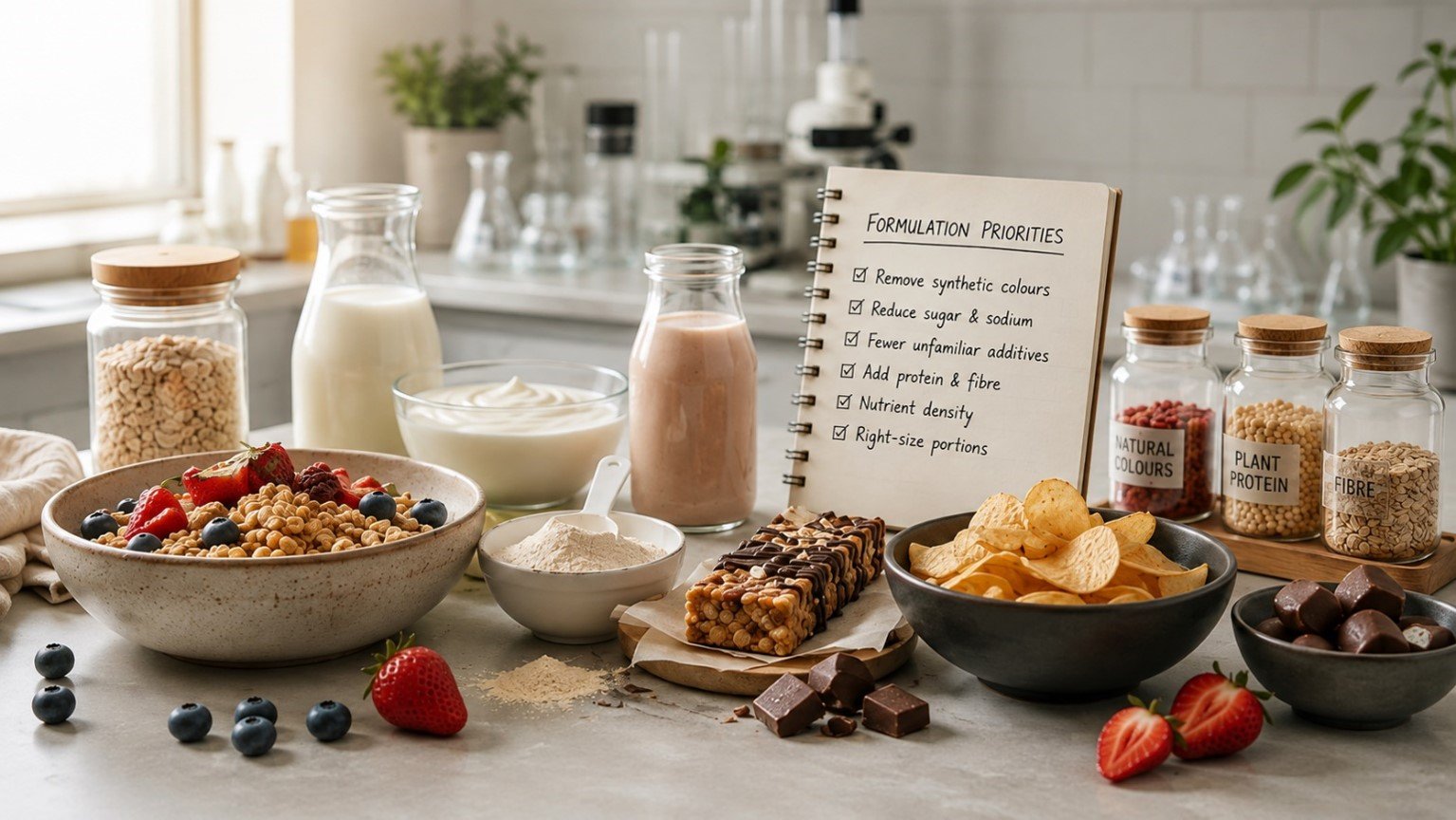
Smaller portions, more protein, cleaner labels. Food companies used to handle health trends by simply adding a few niche products alongside their main lineups. That wall is crumbling. Driven by GLP-1 adoption, massive protein demand, fewer synthetic dyes, and stricter label laws, these forces are fundamentally changing how entire food portfolios are built.
THE INGREDIENT LIST HAS BECOME COMPETITIVE TERRITORY
The most visible change is happening inside products consumers already know. The FDA is working with manufacturers to eliminate the six remaining certified petroleum-based colours – Green No. 3, Red No. 40, Yellow No. 5, Yellow No. 6, Blue No. 1 and Blue No. 2 – by the end of 2027, and publishes a running tracker of company commitments, having already revoked authorisation for Red No. 3 and moved to strike Orange B and Citrus Red No. 2 from the books.1 These are voluntary pledges rather than binding rules, but they are public, dated and comparable, which makes them behave like commitments.
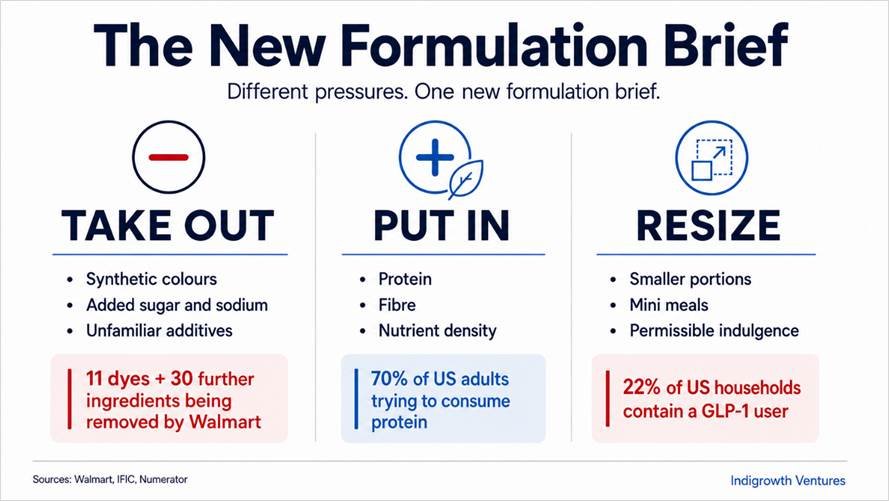
Retailers have made the shift a condition of listing. Walmart is removing 11 synthetic dyes and more than 30 additional ingredients, including titanium dioxide, azodicarbonamide, neotame and bromated flour, from Great Value, Marketside, Freshness Guaranteed and bettergoods by January 2027, a reformulation touching around 1,000 products. Its own customer research found 62% wanting more ingredient transparency and 54% checking labels while shopping, and the company has said some prices may rise as a result.2 Nestlé has taken the same logic global, committing to remove artificial colours from its entire worldwide portfolio by the end of 2026 after completing the US transition, a change its chief technology officer described as years of R&D to find natural alternatives that survive production and hold shelf life.3
That last detail is what separates this from an earlier clean-label cycle. Once reformulation reaches core products rather than a healthier flanker, health scrutiny stops being a marketing brief and starts touching R&D, procurement, manufacturing tolerance and margin.
REGULATION IS MAKING THE INVISIBLE VISIBLE
Across the UK, US and India, recent policy moves are increasing visibility rather than imposing outright prohibition. Britain’s restrictions on advertising less healthy food became legally enforceable in January 2026, introducing a 5:30am-9pm television watershed and a round-the-clock ban on paid-for online advertising,4 with government estimating up to 7.2 billion calories removed from children’s diets each year and, critically, an escape route for products reformulated below the nutrient profiling threshold.5 Reformulation is no longer a positioning choice there; it is the price of staying on air.
In the US, the front panel is the contested ground. The FDA’s proposed Nutrition Info box would put an interpretive low/medium/high reading of saturated fat, sodium and added sugars on most packaged foods,6 and although it drew tens of thousands of comments and remains unfinalised,7 its thresholds are published and can be scored against today. On 10 August 2026, HHS and the USDA went further, submitting the federal government’s first proposed definition of ultra-processed foods for final review, a classification that will decide, for the first time in policy and research, which products carry the label.8 India is on the same axis: in August its Supreme Court criticised FSSAI for failing to decide on front-of-pack warnings, after the regulator stepped back from colour-coded symbols in favour of a table showing recommended daily limits.9
The direction of travel matters more than any single rule. Consumers already compare ingredient lists online and circulate formulation differences between countries. Regulation adds a mandatory layer to that visibility, and it changes the risk equation: a recipe can be entirely legal and entirely familiar, and still be hard to defend when a shopper can compare it in seconds against something simpler. For manufacturers, that turns comparability itself into a market insights question: which of our recipes look indefensible beside the nearest alternative, and in which market first.
PROTEIN HAS ESCAPED THE GYM
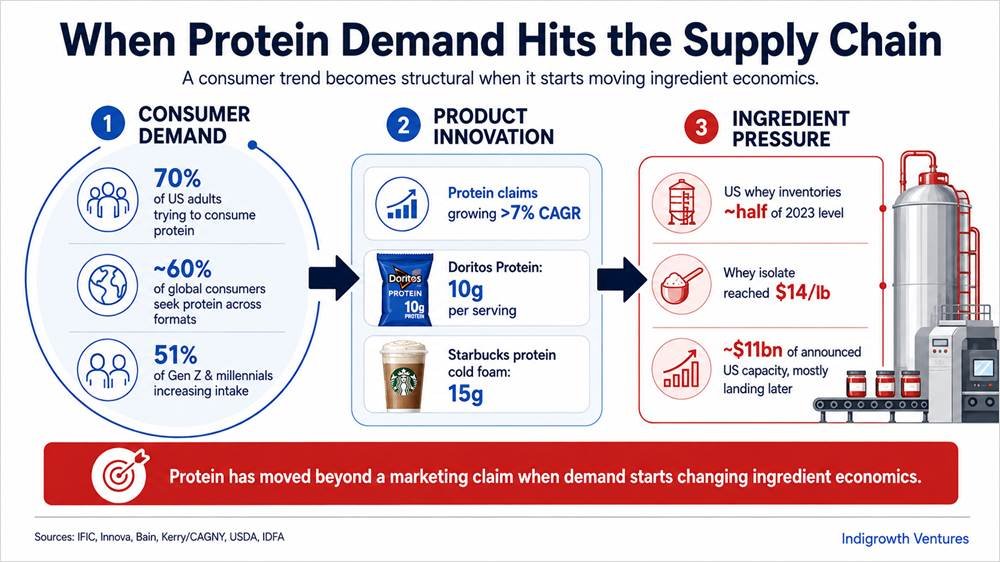
If cleaner labels are what consumers want out, protein is what they want in, and the demand evidence is unusually consistent across independent market research. The International Food Information Council finds 70% of US adults actively trying to consume protein, up from 59% in 2022, with one in three reporting higher intake over the past year.10 Innova Market Insights made “powerhouse protein” its top trend for 2026, with close to 60% of global consumers seeking it across formats and occasions.11 Bain & Company puts the share of US consumers actively increasing intake at 44%, rising to 51% among Gen Z and millennials, while Mintel recorded a quadrupling of high-protein launches between 2013 and 2024.12
The commercial signal is sharper than the consumer signal. Kerry Group told the CAGNY conference in February 2026 that protein has become a design requirement rather than a differentiator, and that US products carrying protein claims are growing at over 7% CAGR against low single-digit growth for those without; Fonterra reported US retail growth of 6.8% in protein bars, 7.2% in sports powders and 7.4% in ready-to-drink protein beverages. The category has moved accordingly: PepsiCo launched Doritos Protein at 10g per one-ounce serving using dairy casein, positioned in its own framing as Doritos first and protein second,13 and Starbucks now attaches 15g to cold beverages through protein cold foam. Policy has moved the same way: the 2025–2030 Dietary Guidelines, released in January 2026, put protein at the wide top of an inverted food pyramid, making it the rare nutrient that regulators encourage adding rather than removing.14
The consequences are showing up upstream. USDA reporting through mid-2026 described the whey market as extremely tight, with isolate reaching $14 per pound and US inventories down roughly half since 2023;15 standard whey powder rose more than 50% between January and May 2026, and roughly $11 billion of announced US capacity will not deliver before late 2026 or 2027.16 Manufacturers are evaluating milk protein concentrate, egg and plant sources for cost and availability rather than nutrition.
GLP-1 CHANGES THE ECONOMICS OF EVERY BITE
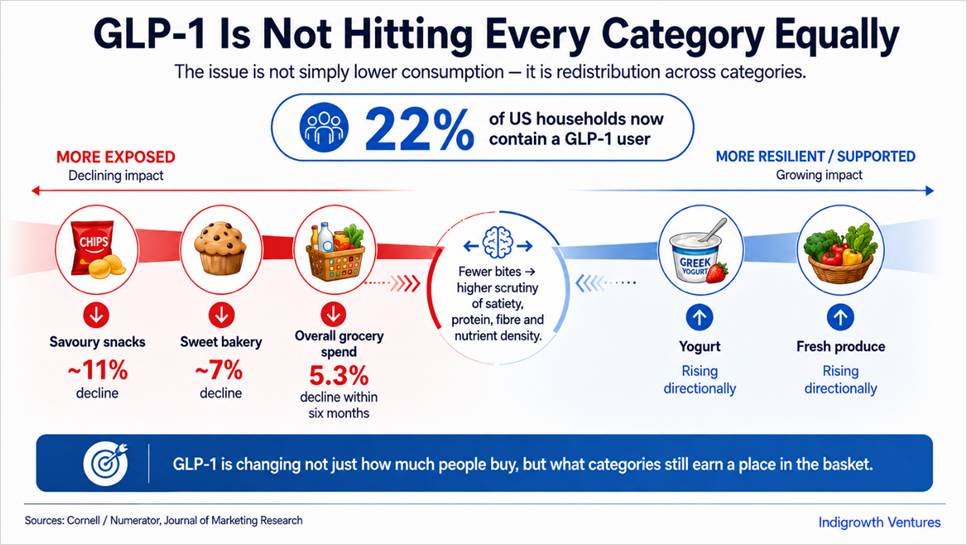
GLP-1 medications add a volume problem underneath the formulation problem. Numerator’s tracker put 22% of US households as containing a current user in August 2026, double the October 2023 share, spending nearly 4% less at grocery after a year than comparable households.17 Cornell research in the Journal of Marketing Research, using transaction data across roughly 150,000 households, found grocery spending down an average of 5.3% within six months of adoption and more than 8% among higher-income households, with the reduction persisting at least a year.18
The cut is not even, and that is the strategically useful part. Savoury snacks fell around 11% and sweet bakery close to 7%, while yogurt and fresh produce rose.19 Fewer bites means each one has to justify itself, which is why protein and fibre have become the default answer. Conagra was first to put the logic on the pack, badging 26 Healthy Choice meals as GLP-1 friendly on the basis of high protein, low calories and fibre-without reformulating the meals themselves.20 PepsiCo attributed its strongest global organic volume growth since 2022 partly to a portfolio moving towards portion control, protein and fibre, and zero-sugar variants.21 FTI Consulting found around 80% of GLP-1 users buying performance and health nutrition products against roughly 67% of the general population.22 The insight that matters is not that every consumer will take a weight-loss drug, but that GLP-1 use reinforces scrutiny of portion size, satiety and nutrient density that was already building without it.
WHERE THE PROTEIN ANSWER IS WEAKEST
Protein is a real growth vector, but a weaker hedge against scrutiny than the current wave of launches assumes. IFIC’s 2026 Food & Health Survey of 3,005 US adults found limiting highly processed foods ranked higher as a healthy-eating action than prioritising protein at every meal, which drew 28%; familiarity with the term “ultra-processed food” reached 52%, up from 32% two years earlier; and convenience overtook healthfulness as a purchase driver for the first time since the survey began in 2006.23 Adding protein does not answer a processing objection.
The claim threshold is also low. UK commentary has settled on “protein washing” for foregrounding protein on products whose wider composition is unchanged: a product need derive only 20% of its energy from protein to carry a protein-packed style claim, a bar most whole foods clear given a single egg contains roughly 7g, and most British adults already meet the reference intake.24 More structurally, a market analysis in Public Health Nutrition comparing 299 high-protein and 286 normal-protein ultra-processed products in Germany is a reminder that high-protein and ultra-processed are usually the same product.25 If the forthcoming US definition classifies by processing rather than composition, some protein innovation built as a hedge will be caught by the rules it was meant to sidestep.
HEALTH IS MOVING INTO THE CORE
The industry is not becoming uniformly healthy. Consumers still want chocolate, crisps and convenience, taste remains the strongest driver of choice and affordability still decides most baskets. What has changed is the threshold of what consumers, retailers and regulators expect from those products-and the fact that four separate pressures now arrive as one formulation brief.
For portfolio owners, three questions follow:
- First, score the existing range against external thresholds rather than internal wellness definitions: the UK nutrient profiling model, the FDA’s proposed cut-offs and the FSSAI criteria are all published, and scoring against them is a contained piece of market research that usually produces a less comfortable number than expected
- Second, separate protein-as-nutrition from protein-as-claim-the first supports pricing and repeat purchase, the second competes against a bar a boiled egg clears, and telling them apart means reading consumer insights and regulatory status together rather than in separate reports
- Third, treat the ultra-processed definition as a scenario rather than a delay; modelling two or three readings now costs far less than redesigning packaging under a compliance clock.
Where reformulation cannot close the gap, companies are buying instead. Danone agreed to acquire the British nutrition business Huel for approximately $1.2 billion under its Renew Danone strategy, taking an established position in nutritionally complete formats rather than building one inside a dairy portfolio.26 Those choices-which brands get R&D, which categories get investment, which get sold-are increasingly decided by how easily a category can absorb the new brief. That makes this a portfolio allocation discussion rather than a health-and-wellness one, and it is the kind of question where good market research changes a decision instead of confirming one.
The next phase of the health shift will not look like the last. It will not arrive as another wellness aisle or another better-for-you brand. It will show up as the colour removed from a cereal, the protein added to a breakfast, the portion taken out of a dessert and the ingredient quietly replaced inside a product people have bought for decades.
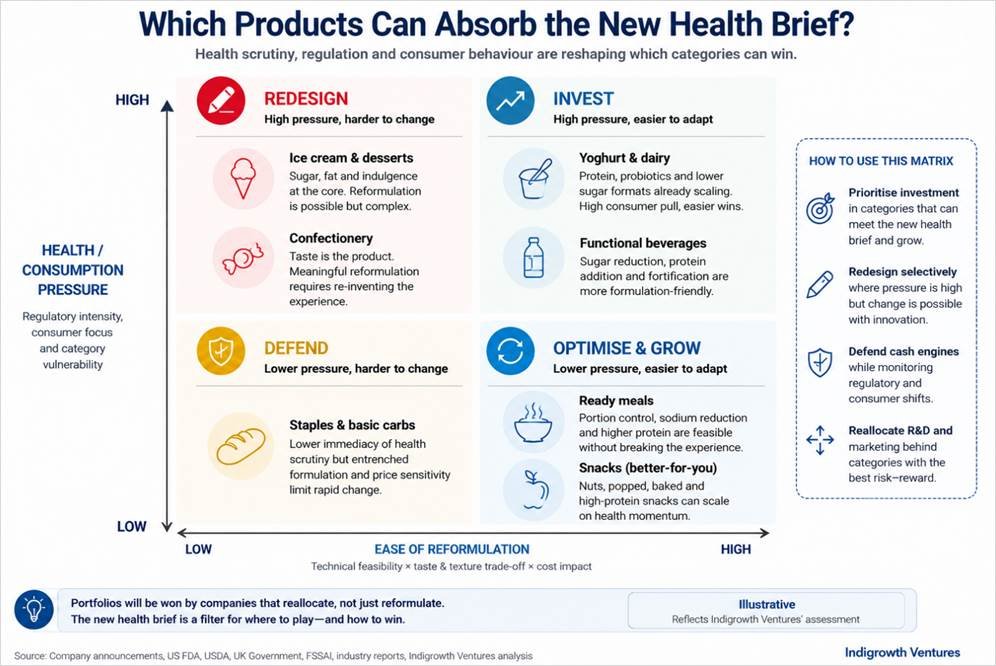
Health is moving from something food companies add to their portfolios to something they have to design their portfolios around.
Understand Issues. Remove Guesswork. Embed Insights.
- Tracking Food Industry Pledges to Remove Petroleum-Based Food Dyes, U.S. Food and Drug Administration, accessed August 2026;
https://www.fda.gov/food/color-additives-information-consumers/tracking-food-industry-pledges-remove-petroleum-based-food-dyes - Walmart U.S. Moves To Eliminate Synthetic Dyes Across All Private Brand Food Products, Walmart, October 2025;
https://corporate.walmart.com/news/2025/10/01/walmart-u-s-moves-to-eliminate-synthetic-dyes-across-all-private-brand-food-products - Nestlé to Remove Artificial Colours From Global Portfolio by End of 2026, FoodNavigator, July 2026;
https://www.foodnavigator.com/Article/2026/07/01/nestle-to-remove-artificial-colours-from-global-portfolio-by-end-of-2026/ - Less Healthy Food and Drink Advertising Restrictions: Regulatory Statement, CAP and BCAP, Advertising Standards Authority, December 2025;
https://www.asa.org.uk/static/35791f5d-ab93-4742-98de2796f0f86aba/Less-healthy-foods-regulatory-statement.pdf - HFSS Advertising Ban Comes Into Force, Meat Management, January 2026;
https://meatmanagement.com/news/hfss-advertising-ban-comes-into-force/85530.article - Front-of-Package Nutrition Labeling (Docket FDA-2024-N-2910), U.S. Food and Drug Administration, accessed August 2026;
https://www.fda.gov/food/nutrition-food-labeling-and-critical-foods/front-package-nutrition-labeling - 2026 FDA Front-of-Pack Labeling Rule Status and Timeline, Packaging Digest, May 2026;
https://www.packagingdigest.com/regulations-standards/fda-front-of-pack-labeling-rule-2026-status-and-timeline - Secretary Kennedy Announces Landmark Food Policy Reforms to Advance President Trump’s MAHA Agenda, U.S. Department of Health and Human Services, August 2026;
https://www.hhs.gov/press-room/hhs-announces-ultra-processed-foods-gras-reforms.html - Front-of-Pack Labels: Where India Stands vs Global Food Labelling Systems, Business Standard, August 2026;
https://www.business-standard.com/economy/news/front-of-pack-labels-where-india-stands-vs-global-food-labelling-systems-126082100626_1.html - Consumer Demand Drives Whey Protein Shortage, Price Increases (citing IFIC research), New Hope Network, May 2026;
https://www.newhope.com/brands/consumer-demand-drives-whey-protein-shortage-price-increases - Protein Market Trends: The Rise of Powerhouse Protein Globally (Top 10 Trends 2026), Innova Market Insights, May 2026;
https://www.innovamarketinsights.com/trends/protein-market-trends-the-rise-of-powerhouse-protein-globally/ - Gen Z and Millennials Fuel the Rising Demand for Protein (citing Bain & Company and Mintel), EMARKETER, accessed August 2026;
https://www.emarketer.com/content/protein-product-trend-2025-consumer-demand-growth - Protein Strategy in 2026: Why High Protein Reformulation Is Now a Structural Business Challenge, BakeryandSnacks, February 2026;
https://www.bakeryandsnacks.com/Article/2026/02/27/protein-strategy-in-2026-why-high-protein-reformulation-is-now-a-structural-business-challenge/ - Trump Administration Unveils New Dietary Guidelines Urging More Protein, Less Processed Food, TIME, January 2026;
https://time.com/7344593/new-dietary-guidelines-protein-processed-foods/ - America Can’t Get Enough of Protein. The Dairy Industry Can’t Keep Up, CNBC, June 2026;
https://www.cnbc.com/2026/06/28/america-cant-get-enough-protein-the-dairy-industry-cant-keep-up.html - Whey Protein Shortage and Price Surge: What Food Companies Face in 2026 (citing USDA, DCA Market Intelligence, IDFA), IndexBox, May 2026;
https://www.indexbox.io/blog/whey-protein-shortage-drives-prices-up-as-demand-surges-in-2026/ - GLP-1 Users’ Grocery Spending Is Dropping (Numerator GLP-1 Usage Tracker), Food Dive, August 2026;
https://www.fooddive.com/news/glp1-weight-loss-drugs-medication-grocery-spend-numerator/827405/ - GLP-1 Users Cut Food Spending by 5.3% (Hristakeva et al., Journal of Marketing Research), Food Business News, December 2025;
https://www.foodbusinessnews.net/articles/29532-glp-1-users-cut-food-spending-by-53 - US Households With GLP-1 Users Cut Their Grocery Spending (Cornell / Numerator), EMARKETER, accessed August 2026;
https://www.emarketer.com/content/us-households-with-glp-1-users-cut-their-grocery-spending - Conagra Brands Introduces Badges on Select Healthy Choice Products, Leading Consumers to GLP-1-Friendly Options, Conagra Brands, December 2024;
https://www.conagrabrands.com/news-room/news-conagra-brands-introduces-badges-on-select-healthy-choice-products-leading-consumers-to-glp-1-friendly-options-prn-122909 - Form 8-K, Second Quarter 2026 Results, Exhibit 99.1, PepsiCo, Inc., U.S. Securities and Exchange Commission, July 2026;
https://www.sec.gov/Archives/edgar/data/0000077476/000007747626000037/q220268-kxexhibit991.htm - GLP-1 Drugs Are Rewriting the Rules of Food (FTI Consulting Survey, March 2026, n=1,007), FTI Consulting, July 2026;
https://www.fticonsulting.com/insights/articles/glp-1-drugs-rewriting-rules-food-beverage - Consumers Developing Their Own Definition of Ultra Processed (IFIC 2026 Food & Health Survey, n=3,005), Food Business News, July 2026;
https://www.foodbusinessnews.net/articles/30695-consumers-developing-their-own-definition-of-ultra-processed - What Is “Protein Washing” and Are Shoppers Being Fooled by It?, The Independent, via AOL, June 2026;
https://www.aol.com/articles/protein-washing-shoppers-being-fooled-095536293.html - Nutritional Value and Environmental Aspects of High-Protein Ultra-Processed Foods on the German Market (Koop et al.), Public Health Nutrition, Vol. 27, January 2024;
https://doaj.org/article/7460c0356ab14a8dbd6d63500b73b40b - Q1 2026 Mergers, Acquisition and Investment in the Supplement Sector, NutraIngredients, March 2026;
https://www.nutraingredients.com/Article/2026/03/31/q1-2026-mergers-acquisition-and-investment-in-the-supplement-sector/

