

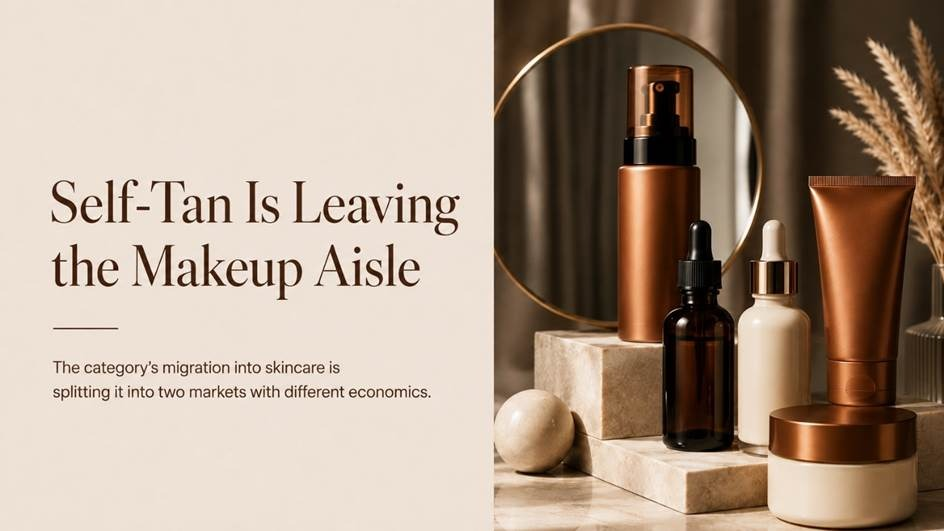
Self-tan is moving from an occasional colour product into a year-round skincare and body-care routine. That shift is changing usage frequency, price architecture, retail placement and the range of brands able to compete.
The strategic signal: a $1.3 billion category is changing its growth model
The self‑tan market is evolving – growth now rests on new foundations, and that shift matters more than the headline number. The global category stands at ~$1.34 billion in 2026 and is forecast to reach $1.74 billion by 2031, driven by a shift in consumer behaviour that is structural rather than cyclical.¹ In the United States, prestige channel sales alone reached $114.6 million in 2024.² In the UK, a more mature market, Circana recorded 43% YoY sales growth in the twelve months to April 2026.³ US consumer searches for sunless tanners grew 55.3% in 2025 – a rate that substantially outpaces underlying volume growth and signals a consumer base still in early discovery.⁴
The more important change is how growth is being created. Traditional foams, mousses and express lotions remain the category’s volume foundation. Alongside them, drops, serums, mists and gradual body-care products are creating a second usage system designed to sit inside existing routines – changing the category’s economics in four ways:
● Higher frequency: maintenance replaces a handful of pre-event applications
● Lower seasonality: gradual glow products can be used throughout the year
● Premium price architecture: facial formats are benchmarked against skincare, not only tanning
● A wider competitive set: skincare, suncare and body-care brands can enter credibly
For beauty and personal care leaders, this is where market research becomes strategically useful: identifying the change in usage behaviour before it becomes a settled category and retail architecture
Why the shift is durable: the consumer has already changed
The transition is rooted in a lasting change in consumer health literacy. SPF, UV avoidance, antioxidants and barrier protection are now established elements of skincare education. That has not removed the desire for bronzed skin, which continues to be associated with radiance, health and an aspirational “glow” aesthetic across beauty and social media; it has changed the acceptable route to achieving it.
The American Academy of Dermatology found that more than one in five Gen Z respondents prioritised getting a tan over protecting their skin, while 25% said looking good now could be worth the longer-term trade-off. Self-tan occupies the gap between a persistent aesthetic preference and rising awareness of UV damage.5
Market evidence layer: three signals behind the shift
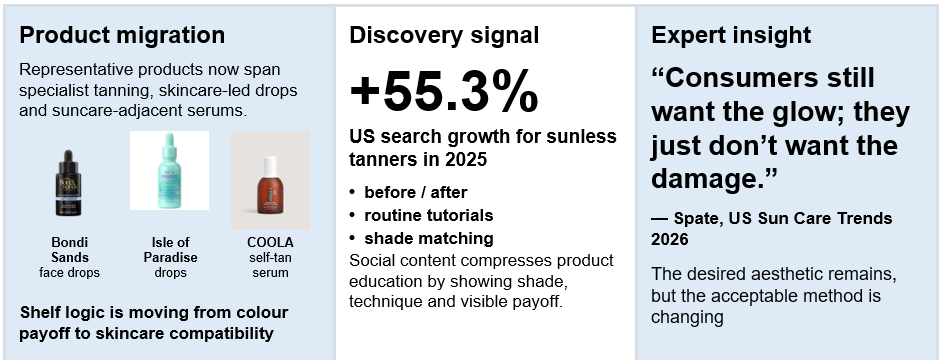
The repositioning is also emotional, not only functional. Self-tan is no longer being sold only as a shortcut to colour; it is increasingly positioned as a controlled, skincare-compatible way to look healthier, more polished and more radiant. The consumer is not simply buying “tan”. She is buying a visible outcome that fits the language of self-care, wellness and everyday beauty
Social platforms are reshaping discovery and product education. Vogue Business reports more than 705,000 TikTok posts under #Tanning, while one unconventional tanning-mousse application video attracted over 4.6 million view, while Spate recorded 55.3% growth in US searches for sunless tanners during the year. These signals do not prove repeat purchase, but they show how tutorials, demonstrations and visible results are reducing the learning barrier around self-tan
The mechanism is reinforcing:
● Health framing: “glow without UV damage” replaces the older “fake tan” proposition
● Routine compatibility: drops and serums reduce the skill and time barrier
● Skincare language: hydration, brightening and tone-evening increase relevance beyond colour alone
● Social proof: demonstrations and before/after content compress product education
What the market looks like now: two speeds, one category
The self-tan market is no longer moving as one format-led category. It is splitting into two related but economically different segments: a traditional performance-tanning business that still anchors volume, and a faster-growing routine-glow business that is pulling the category closer to skincare
| Market Speed | What it Includes | Commercial Meaning |
|---|---|---|
| Performance tanning | Mousses, foams, lotions and express formats used before holidays, events and summer occasions. | Remains the volume foundation. Lotions and creams continue to be the largest product segment by market share. |
| Routine glow | Drops, serums, mists and gradual body-care formats, often supported by ingredients such as hyaluronic acid, vitamin C, peptides or barrier-care language. | The value engine. Drops and serums are the fastest-growing format, forecast at 6.9% CAGR through 2031 versus 5.3% for the overall category. |
The price architecture is already following the format shift. At Ulta, TAN-LUXE THE FACE self-tan drops are listed at USD 55, COOLA’s Organic Sunless Tan Anti-Aging Face Serum at USD 54, and bronzing/self-tan drops with skincare positioning sit in the same USD 25-75 band as many prestige skincare and complexion products.6
The implication is clear: the category’s volume base remains intact, but the value pool is shifting toward products that behave more like skincare – higher frequency, higher price, broader relevance and lower dependence on summer demand.
Why the economics change
| Frequency | Premiumisation | Adjacency |
|---|---|---|
| Maintenance use creates more replenishment occasions than pre-event application. | Facial drops and serums can be priced against skincare value cues. | Brands can enter from routines consumers already understand and trust. |
Retail implication: a more resilient beauty aisle play. For grocery, pharmacy and beauty retailers, self-tan’s value goes beyond product innovation. A Forbes article notes that, unlike suncare, which is more exposed to weather and seasonal demand, self-tan can play a more resilient role across the beauty aisle. As the category moves into gradual glow, body care and skincare-led formats, it gives retailers a proposition that can support basket size beyond peak summer demand
The shift in format, frequency and pricing is also changing where self-tan sits within the wider beauty market. It is no longer confined to a specialist tanning aisle; the category now overlaps with suncare, skincare and body care
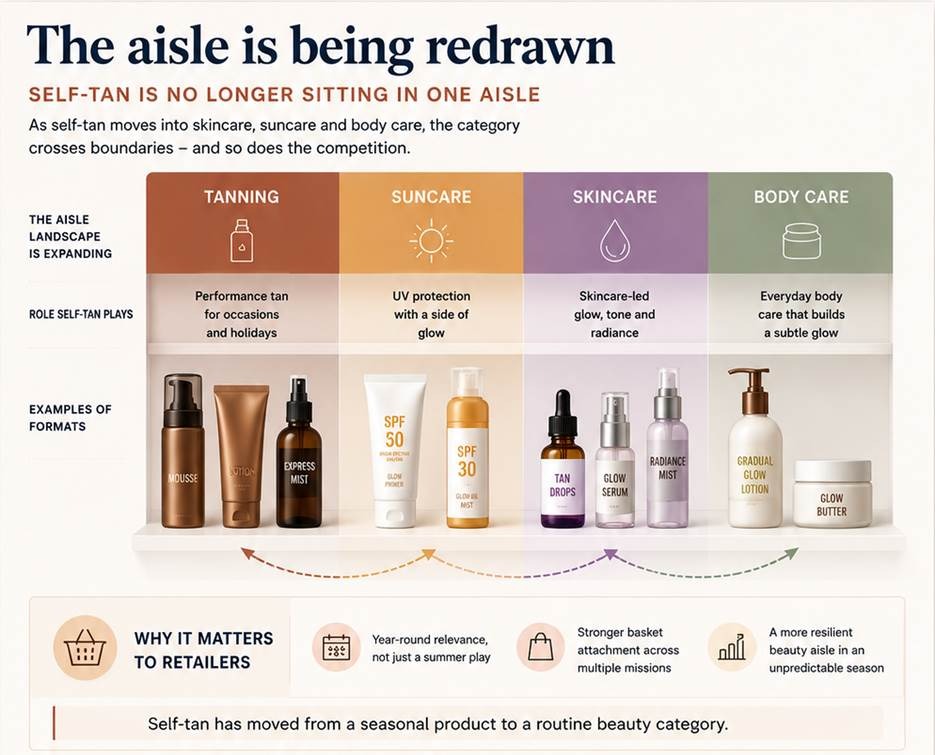
Self-tan is crossing traditional beauty boundaries. Performance tanning remains the category’s base, while UV-free glow, facial serums and gradual body-care formats broaden its retail role and competitive set.
Who has already moved: the competitive map is being redrawn
The competitive map is no longer defined by tanning specialists alone. Established self-tan brands are moving into skincare-compatible formats, skincare and suncare players are entering through skin-health adjacencies, and prestige beauty brands are extending complexion and radiance propositions into sunless glow.
All three are converging on the same high-value territory: routine-use, skincare-compatible, premium-priced glow. As a result, competitive advantage is shifting away from tanning expertise alone and toward ownership of the consumer’s broader year-round glow routine
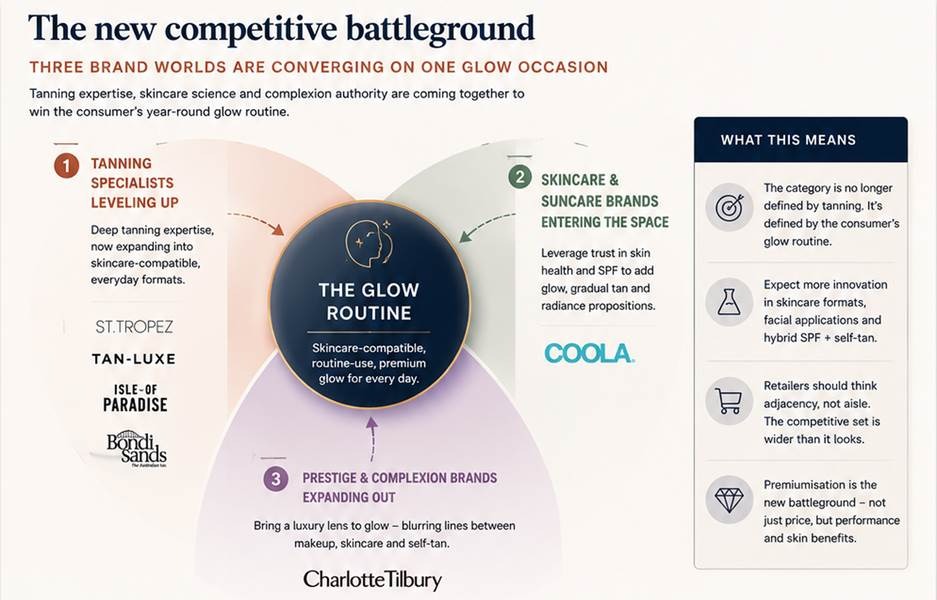
This convergence changes the basis of competition. Tanning expertise remains valuable, but it must now compete with skincare credibility, complexion authority and established daily-use behaviour. The winners will not necessarily be the brands with the strongest association with “tan”; they will be those that make glow easiest to incorporate into a trusted beauty routine
Why Kao’s Bondi Sands acquisition matters
Kao’s treatment of Bondi Sands is one of the clearest signals that self-tan is being reclassified as a broader skincare and skin-protection opportunity, not a narrow seasonal tanning category
Bondi Sands brought Kao a brand with presence across self-tanning, suncare, skincare and body products, available in more than 32 markets. The acquisition gave Kao a stronger platform in sun-adjacent beauty and allowed it to connect self-tanning with its wider skin-protection capabilities.7 In 2024, Kao further positioned Bondi Sands inside its EMEA skincare growth strategy and linked it to its ambition to double its EMEA Consumer Care business by 2030.8
The signal is important: large beauty groups are not only buying category scale. They are buying the right to participate in a consumer behaviour shift where sun protection, skin health, body care and cosmetic glow are increasingly connected9
Strategic takeaway
The category is being redefined around consumer mission, not legacy product format. A consumer looking for a year-round glow may now choose between a tanning specialist, a suncare brand, a skincare brand, a body-care brand or a prestige complexion player. That makes the category more attractive, but also harder to defend10
For incumbents, the risk is not only losing share to another tanning brand. It is losing the consumer relationship to brands that already own skincare credibility, complexion authority or daily routine behaviour.
Where the US sits: early-stage, high-velocity, time-sensitive
The UK and Australia remain useful reference markets because sunless tanning is more culturally established and retailer assortments are deeper. In the UK, self-tan sales increased 43% in the twelve months to April 2026. The US is earlier in the adoption curve: 55.3% search growth in 2025 points to rapidly expanding awareness, while the $114.6 million prestige market confirms meaningful commercial scale.
Taken together, these market insights suggest that the US is in a high-value transition window: consumer interest is rising, but habits, shelf architecture and brand preference are still being formed
Three decisions that cannot wait
As self-tan shifts toward skincare-led routine glow, three groups need to act now: brand owners, retailers and strategy advisers
| For Brand Owners and CMOS | For Retail and Category Leaders | For Strategy and Advisory Teams |
|---|---|---|
| · Choose the route: reposition an existing brand, extend from skincare or body care, or acquire capability· · Build a genuine product thesis around tone, ease, sensitive-skin performance, fragrance and repeat use – not an ingredient badge alone · Communicate “healthy-looking glow without UV exposure”, while making clear that self-tan does not replace SPF | · Organise around consumer missions – facial glow, gradual body colour, sensitive-skin tanning and express transformation. · Use cross-merchandising and digital navigation to connect self-tan with skincare, body care and suncare · Reassess price ceilings and margin pools as facial formats move into prestige skincare bands | · Treat self-tan as a live case of category-boundary erosion driven by health framing, ingredient crossover and routine integration · Apply the same lens to scalp care, functional body care, teeth whitening and at-home aesthetic categories · Track leading indicators – search, launch formats, retailer placement, pricing and M&A – before sales alone make the shift obvious |
The category is mid-transition. Decisions made now will be difficult to reverse later.
Self-tan’s move from seasonal colour cosmetic to year-round skincare routine is not a future scenario. It is happening now, in formats on the Sephora shelf, in M&A rationale, in search data, and in the pricing decisions of every brand that has crossed $40 for a facial tanning serum and held that price point. The category is at the moment in its transition where consumer awareness is building but habits are not yet formed, where competitive positions are being established but not yet entrenched, and where the organisations moving with intention are creating distance from the ones still waiting to see how it plays out.
The brands that treat this as a formulation update will find themselves correctly positioned for the category as it was. The brands – and the advisers – that treat it as a category redefinition will find themselves correctly positioned for the category as it is becoming. That distinction, made clearly and acted on now, is the difference between leading the next phase of this market and responding to it.
For market research and strategy teams, self-tan offers a useful signal of how beauty categories are being redefined by health framing, routine behaviour and cross-category competition
Understand Issues. Remove Guesswork. Embed Insights
1. Mordor Intelligence, Self-Tanning Products Market Size, Share, 2026–2031 Outlook.
https://www.mordorintelligence.com/industry-reports/self-tanning-products-market
2. BeautyMatter, Going for Gold: An Inside Look at the Booming Self-Tanning Industry, May 2025.
https://beautymatter.com/articles/an-inside-look-at-the-booming-self-tanning-industry
3. Circana, cited in Cosmetics Business, June 2026.
https://cosmeticsbusiness.com/self-tan-sales-rise-43-as-sunless-tanning
4. Spate, Sun Care Trends 2026, cited in Cosmetics Business, June 2026.
hhttps://cosmeticsbusiness.com/self-tan-sales-rise-43-as-sunless-tanning
5. American Academy of Dermatology, Survey: Half of Gen Z Got Sunburned in 2024, 2025.
https://www.aad.org/news/survey-gen-z-sunburned
6. Ulta Beauty, Best Self Tanners 2026.
https://www.ulta.com/discover/skin/summer-skin-prep-routines
7. Kao Corporation, Kao to Acquire Bondi Sands, August 2023.
https://www.kao.com/global/en/newsroom/news/release/2023/20230801-001/
8. Kao Corporation, Kao Accelerates Growth Strategy for Consumer Care Business Following Bondi Sands Acquisition, 2024.
https://www.kao.com/emea/en/news/2024/2/4_kao_accelerates_growth_of_consumer_care_business/
9. Forbes, Glow With Purpose: How Self-Tan Became Skincare’s Sophisticated Power Player, Apr 2025,
https://www.forbes.com/sites/katehardcastle/2025/04/19/glow-with-purpose-how-self-tan-became-skincares-sophisticated-power-player/
10. Vogue Business, “Gen Z wants to tan safely this summer. Should brands tap in?”, July 2025,
https://www.voguebusiness.com/story/beauty/gen-z-wants-to-tan-safely-this-summer-should-brands-tap-in

