


More pilots. More copilots. More AI agents. Yet value still lags adoption. Governance, skills, data, legacy systems and regulation – not model access – are becoming the real barriers to scale. The next phase of AI will be defined by how well enterprises can govern, integrate and operationalize it.
THE WARNING SIGN: AI ENTHUSIASM IS NOT AI REVENUE
On June 18, 2026 the world’s largest consulting firm Accenture posted a healthy quarter – revenue up 6% to $18.7B and EPS up 9%. Yet its stock plunged 18% in a single day – the worst drop in its history as a public company. The trigger: new bookings fell 2% to $19.3B, down 13% from the prior quarter’s record, and full‑year guidance was cut.1
Bloomberg Intelligence pointed to AI as a factor disrupting demand across consulting and managed services, while Morgan Stanley downgraded the stock, citing enterprise IT budget growth that has “yet to materialize” even as AI adoption accelerates. 2 3
For a firm that had built its growth story on being the enterprise world’s AI implementation partner, the sell‑off underscored a broader truth: AI enthusiasm and AI revenue are not the same.
THE ADOPTION-IMPACT GAP: AI IS EVERYWHERE, VALUE IS NOT
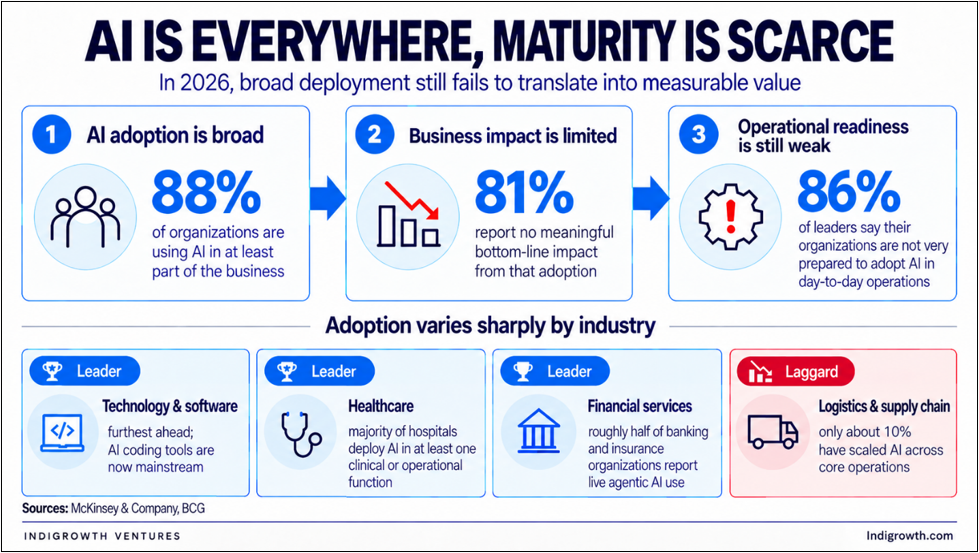
By 2026, the vast majority of organizations have deployed AI somewhere in their operations yet no meaningful bottom-line impact observed from that adoption; in the US only 1% of C-suite executives describe their GenAI rollouts as “mature.” in McKinsey’s State of Organizations 2026 survey of 10,000+ leaders.4
This gap between adoption and impact is the defining story of AI in 2026. Deploying a tool is easy; making it work at scale is not. Moreover, the pace of AI adoption is far from uniform across sectors, and the gap between leaders and laggards is widening. For example, technology and software companies, Healthcare, and financial services sectors lead AI adoption, while logistics and supply chain operators lag behind.5 This uneven progress means that “AI adoption” looks very different depending on which industry – and which function within it – is being measured.
WHY AI STALLS AFTER THE PILOT?
As organizations move from simple generative AI tools toward autonomous “agentic” AI systems that can take actions on their own, oversight is falling behind.
- 78% of leaders believe AI adoption is outpacing their organization’s ability to manage the risks it creates, and 52% of department-level AI initiatives are running without any formal approval process – EY’s Technology Pulse Poll, Feb 2026.6
- 78% of executives lack strong confidence they could pass an independent AI governance audit within 90 days, and among organizations still in the earliest stage of AI exploration, that confidence drops to zero, as per Grant Thornton’s survey7
- Only one in five companies has a mature governance model for AI agents, even as agentic AI usage is expected to grow sharply over the next two years, as per Deloitte’s 2026 State of AI in the Enterprise8
AI can’t outrun bad data and legacy systems
AI models are only as good as the data and infrastructure underneath them. Enterprise technology research firm Vention reports that nearly 60% of organizations cite integration with legacy systems, along with managing risk and compliance, as the top barriers to scaling agentic AI, with a shortage of technical expertise close behind.
Fragmented, siloed, or poor-quality data doesn’t just slow deployment, it actively degrades model performance once systems go live, which helps explain why so many pilots stall before reaching production.
The skills gap: confidence is outrunning competence
Market identifies the AI skills gap as the single biggest barrier to deeper integration, ahead of workflow or role redesign. This shows up across levels of the organization.
Gallagher’s survey found that more than half of businesses report skills gaps and recruitment challenges as a top concern, while Informatica’s 2026 CDO Insights survey found that 75% of data leaders believe their employees need serious upskilling in data literacy and 74% need AI literacy, despite 65% of those same employees already trusting the data behind AI outputs without question.9
Informatica calls this mismatch between confidence and competence the “trust paradox,” and it is a quiet but persistent drag on safe, effective use of these tools. In response, 86% of companies surveyed by Informatica plan to increase data management and upskilling investment this year.10
The risk stack is growing: regulation, liability and reputation
Regulatory uncertainty remains a top-tier concern, particularly outside the US. McKinsey’s State of Organizations 2026 survey found that 44% of respondents cite regulatory, ethical, and legal concerns as a major barrier to scaling AI, rising to 48% among European leaders and 56% in Germany specifically.
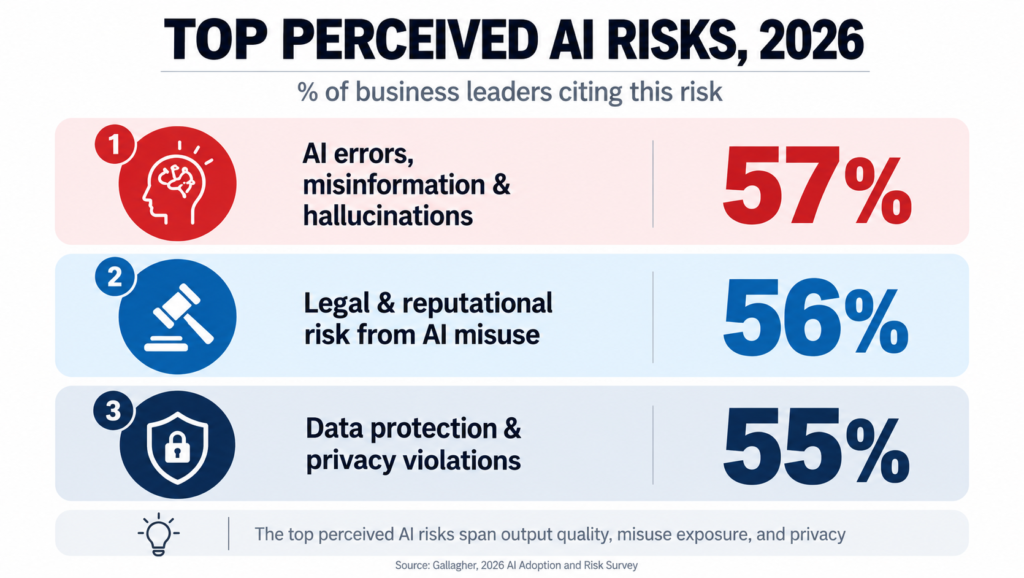
This concern is not abstract. Gallagher’s 2026 survey tracked more than 200 active legal cases involving AI and machine learning tied to data bias, privacy violations, and discrimination. The same survey found that AI errors, misinformation and hallucinations, legal and reputational risk from AI misuse, and data protection and privacy violations are now the three most commonly cited threats from AI adoption among business leaders, shown below.11
The human bottleneck: Work is changing faster than organizations can
AI adoption is reshaping day-to-day work faster than most organizations can manage the transition. Gallup’s Feb 2026 survey of nearly 24,000 US employees found that workers at organizations that have adopted AI report more disruption, and more change in staffing levels, both positive and negative – than those at organizations that haven’t. Just 41% of employees say their organization has meaningfully integrated AI into how work gets done, even though far more report using AI tools individually.12
McKinsey’s research adds another layer: 46% of leaders cite concerns about AI itself – bias, intellectual property exposure, and the threat to jobs – as the top obstacle to scaling AI, ahead of cost or technical limitations. In other words, the human and cultural side of adoption is now a bigger barrier than the technology itself.
WHERE THE TECHNOLOGY LEADERS ARE FOCUSED IN 2026
As AI adoption broadens, the pressure to turn it into results is landing squarely on the CIO. Gartner’s 2026 Leadership Perspective Survey of 1,400 IT executives, found that “Operationalizing AI” has overtaken cybersecurity to become the top functional priority for CIOs this year – the first time AI has topped the list since Gartner began tracking it in 2024, when it ranked fourth. The image below summarizes the top three priorities CIOs identified for 2026.13
CIOs focused on operationalizing AI report three main goals: improving business outcomes (74%), improving processes and efficiencies (63%), and clearly defining and delivering measurable value (44%). But the path there is not smooth. Their top obstacle by a wide margin is a lack of skilled talent, followed by the pace at which the technology itself is changing, and competing organizational priorities that pull budget and attention away from AI work. Several CIOs surveyed described actively working to weed out low-value “AI vanity projects” and instead starting from a genuine business problem and working backward to an AI solution, rather than the reverse.
Governance concerns run through all three priorities. CIOs scaling agentic AI are increasingly focused on guardrails for a growing number of AI agents and on driving adoption beyond engineering teams into non-technical roles, where finding relevant use cases is harder. On cybersecurity, CIOs describe an “AI paradox”: the same technology making attackers faster and more capable is also strengthening detection and defense. And on data, CIOs consistently point out that AI and analytics success is impossible without strong data foundations – making data quality as much a leadership priority as a technical one.
These functional priorities line up with what CIOs are trying to achieve enterprise-wide. In 2026, CIOs named increasing operational efficiency and productivity as their top enterprise priority – shared with their CFO peers – followed by driving growth, the top priority for CHRO, CISO, and CDAO peers alike. That alignment across the C-suite is itself a signal of how central AI has become to overall business strategy, not just to the IT function.
WHAT SEPARATES TOP PERFORMING ENTERPRISE FROM REST
| McKinsey’s research puts a number on that divide: just 6% of organizations currently qualify as AI “high performers” capturing significant enterprise-wide value from their investment, while 72% of leaders admit their organizations are not fully ready for the changes AI is bringing.14 |
Taken together, these insights reveal a pattern: the technical barrier to using AI has largely disappeared, but the organizational barriers have not. Governance, data readiness, skills, trust, regulatory clarity, and change management – not model capability – are what separate the small group of companies capturing real value from the large majority still stuck in pilot mode.
WHERE MSPs CAN TURN FRICTION INTO VALUE
The barriers above share a common theme: Enterprises do not simply need access to AI technology. They need the surrounding capabilities that make AI dependable in the real world. That creates a services opportunity across the entire lifecycle – assess, design, modernize, build, integrate, secure, govern, operate and optimize.
MSPs are well placed to lead large transformation programs, complex systems integration, application modernization and global rollout. MSPs can build on their operational heritage to manage AI platforms, infrastructure, model services, observability, security, FinOps and service levels after deployment. The lines will increasingly blur as both groups build end-to-end capabilities, but the recurring operational layer is particularly important: AI systems will need continuous evaluation, policy updates, cost tuning and performance management long after the initial project ends.
This points toward a broader category of managed AI services. Rather than selling only implementation capacity, providers can package repeatable capabilities around model operations, AI security, governance, data services and optimization. The strongest offerings will combine platform expertise with vertical knowledge – understanding not only how the technology works, but how a bank, manufacturer, retailer or healthcare organization must operate it in context.
The opportunity is significant, but it is not automatic. Traditional infrastructure and cloud skills remain relevant, yet service providers also need AI engineering, data architecture, governance, security and domain expertise. They will need reusable intellectual property, reference architectures and strong technology partnerships. Commercial models may also shift from people-and-hours toward managed platforms, automation and measurable outcomes.
THE WINNERS WILL OPERATE AI, NOT DEMO IT
The constraint on AI adoption in 2026 is not model access. It is turning models into dependable organisational capability – and the obstacles compound. Poor data undermines reliability. Weak skills suppress adoption. Thin governance widens regulatory exposure. Unclear ownership stalls ROI. Vendor dependence erodes resilience. Fixed one at a time, each yields a patch and no system.
Advantage will belong to organisations that organise AI around business outcomes rather than tools: redesigning workflows, measuring value, naming owners, building controls into the architecture and keeping flexibility across models and vendors. As AI gets cheaper and more autonomous, management quality matters more, not less. The divide is between companies that can experiment with AI and companies that can operate it at scale.
That gap is the opening for MSPs. Providers that bind cloud, data, applications, security and AI into one dependable operating model stop being implementation partners and become the layer that makes enterprise AI work.
Understand Issues. Remove Guesswork. Embed Insights.
- Accenture Reports Third-Quarter Fiscal 2026 Results, June 18, 2026,
https://investor.accenture.com/~/media/Files/A/accenture-v4/investors/earnings-reports/2026/accenture-3q-fy26-earnings-release.pdf - Bloomberg, Accenture Outlook Falls Short With Consultancy Demand Under Pressure, June 18, 2026,
https://www.bloomberg.com/news/articles/2026-06-18/accenture-s-outlook-disappoints-in-uncertain-consultancy-market - Investing.com, Accenture Earnings Ahead as Investors Weigh AI Opportunity vs. Risk, June 2026,
https://www.investing.com/news/earnings/accenture-earnings-ahead-as-investors-weigh-ai-opportunity-vs-risk-93CH-4747556 - McKinsey & Company: The State of Organizations 2026,
https://shorturl.at/HpUJn - BCG: AI Is Already Moving the Logistics Industry Forward, March 2026,
https://www.bcg.com/publications/2026/ai-is-already-moving-the-logistics-industry-forward - EY: Technology Pulse Poll, March 2026 (based on 500 US technology leaders),
https://www.ey.com/en_us/newsroom/2026/03/ey-survey-autonomous-ai-adoption-surges-at-tech-companies-as-oversight-falls-behind - Grant Thornton: 2026 AI Impact Survey,
https://www.grantthornton.com/services/advisory-services/artificial-intelligence/2026-ai-impact-survey - Deloitte: The State of AI in the Enterprise 2026 (based on 3,235 global leaders),
https://www.deloitte.com/us/en/what-we-do/capabilities/applied-artificial-intelligence/content/state-of-ai-in-the-enterprise.html - Gallagher: 2026 AI Adoption and Risk Survey,
https://www.ajg.com/news-and-insights/features/ai-adoption-and-risk-benchmarking-2026/ - Informatica: CDO Insights 2026 (based on 600 data leaders),
https://www.informatica.com/blogs/cdo-insights-2026-ai-adoption-accelerates-but-trust-and-governance-lag-behind.html - Vention: AI Adoption Statistics Q1 2026
https://ventionteams.com/solutions/ai/adoption-statistics - Gallup: Rising AI Adoption Spurs Workforce Changes, April 2026,
https://www.gallup.com/workplace/704225/rising-adoption-spurs-workforce-changes.aspx - Gartner C-level Communities / Evanta: Top 3 Priorities for CIOs in 2026,
https://www.evanta.com/resources/cio/survey-report/top-3-priorities-for-cios-in-2026 - McKinsey & Company: The State of AI: Global Survey,
https://www.mckinsey.com/capabilities/quantumblack/our-insights/the-state-of-ai

