


The AI bubble has not burst everywhere at once. It has burst in the markets that were most crowded, leveraged and concentrated (China and South Korea), while the US is in a sharp but so far orderly correction. For enterprise buyers, the repricing is less a crisis than a shift in negotiating power.
HOW MUCH INVESTORS HAVE LOST
$9.8tnof paper value has gone from AI-linked stocks across five markets since their 2026 peaks. That is our triangulated total from published market research and exchange data, compiled on 12 November 2026.
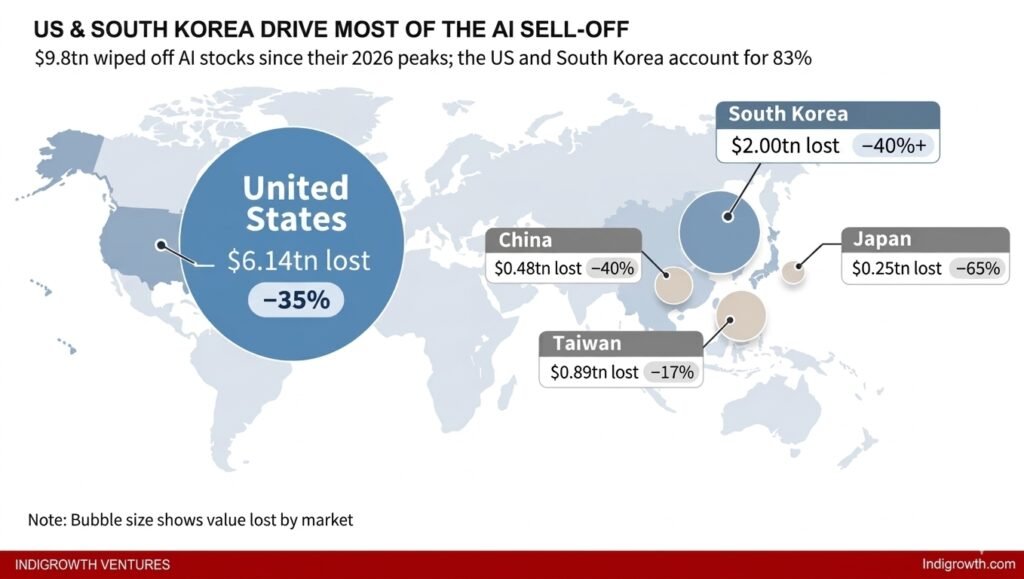
- United States, the biggest dollar loss. Six AI leaders have shed about $ 6.14tn from their 2026 highs, a combined fall of 35%. Measured to 8 November 2026, Alphabet lost $1.62tn (−32%), Broadcom $965bn (−41%), Micron $678bn (−48%) and Meta $501bn (−25%)[1]. Oracle lost about $412bn (−53%) between its 1 June 2026 high and 6 November 2026[2]. Nvidia lost about $1.96tn (−33%) once its value fell below $4tn on 12 November 2026, the day Jensen Huang resigned [1][3]. The selling also spread across the whole US market, which lost about $5.7tn between its 6 October 2026 peak and 7 November 2026[4]; on 5 November 2026 alone, about $2.5tn was wiped off the Nasdaq 100[5]. Those market-wide totals cover different periods and stocks, so they are not added to the AI total.
- South Korea, the deepest fall relative to its size. Between its 22 June 2026 record close and 6 November 2026, the KOSPI fell more than 40%, a loss of more than $ 2tn[6].
- Taiwan, China and Japan. The TAIEX was about 17% below its June 2026 high on 6 November 2026[7]. Applied to Taiwan’s $4.36tn market value on 12 November 2026[8], that implies roughly $0.9tn lost. China’s STAR50 lost about $480bn between its July 2026 peak and 26 October 2026[9]. In Japan, memory maker Kioxia alone lost about $247bn (¥39tn) as its market value fell from roughly ¥60tn in June 2026 to about ¥21tn by October 2026[10].
- Europe, largely spared. It has few pure AI stocks, so the damage is concentrated in chip-equipment makers such as ASML (next section).
WHAT TRIGGERED THE SELL-OFF?
The 3 November 2026 midterms were the trigger, not the cause. The vote let several long-building doubts be sold on the same day. Six drivers stand out.
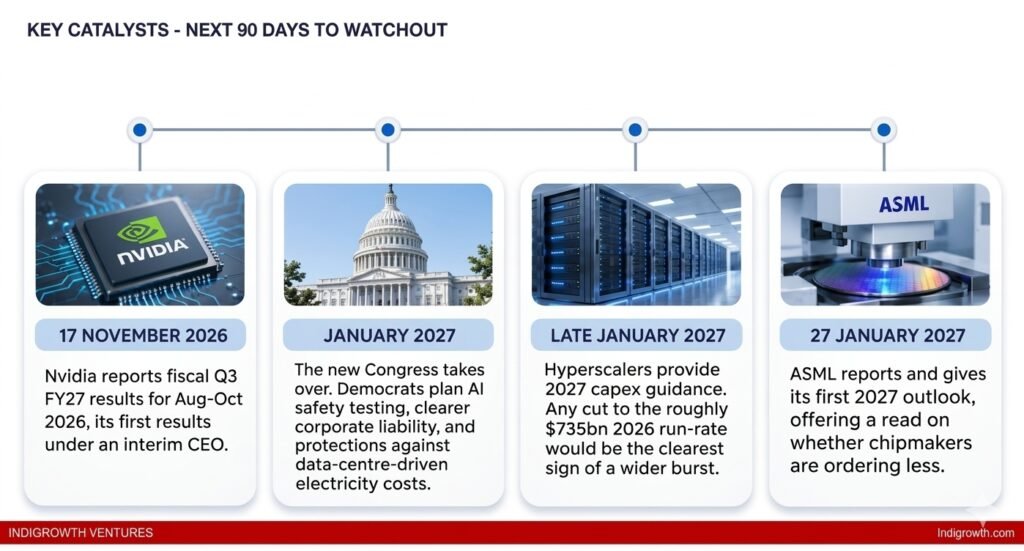
- Policy risk for data centres. On election night, Senator Bernie Sanders called for a “national data center moratorium now” [11]. A federal moratorium faces long odds and a presidential veto[12]. But tighter rules on power, permitting and AI safety now look likely from January 2027, when the new Congress sits.
- A gap between spending and returns. Amazon, Alphabet, Microsoft and Meta guided to about $735bn of 2026 capex, up roughly 79% on 2025[13]. In China, combined free cash flow at Alibaba, Tencent and Baidu swung from about $25.5bn (CNY170bn) in 2025 to minus $2.4bn (−CNY16bn) in H1 2026[14].
- Debt behind the build-out. JP Morgan estimates about $4.1tn of AI capex will be debt-financed between 2026 and 2030[15]. The Bank of England is now questioning lenders about data-centre projects financed without a tenant [16]. The most indebted names fell hardest: CoreWeave is about 56% below its 2026 high and Oracle about 48% after a partial rebound from its 6 November 2026 low, as of 12 November 2026[17].
- Leverage and concentration in Asia. In Korea, falling prices triggered margin calls that forced more selling [18]. In China, AI stocks were 42% of market value and 57% of turnover, so losses spread widely among retail investors [19].
- Export controls and geopolitics. China’s crash was compounded by curbs on Chinese exports[9]. ASML’s CFO has warned that a proposed US ban on DUV sales to China could resurface after the midterms; China is about 20% of ASML’s expected 2026 sales [20].
- A leadership shock at Nvidia. Jensen Huang resigned on 12 November 2026 after a board probe into his links to an alleged Chinese intelligence asset; CFO Colette Kress is interim CEO[21]. Nvidia fell below $4tn in market value for the first time since July 2025 [3].
BURST OR CORRECTION?
Burst in two markets, correction in the rest. A bubble burst is characterized by three conditions occurring simultaneously: prices fall 35% or more, leverage is forced out, and the funding window shuts. Only China and South Korea meet all three today.
WHERE THE BUBBLE HAS BURST: OUR VERDICT BY MARKET
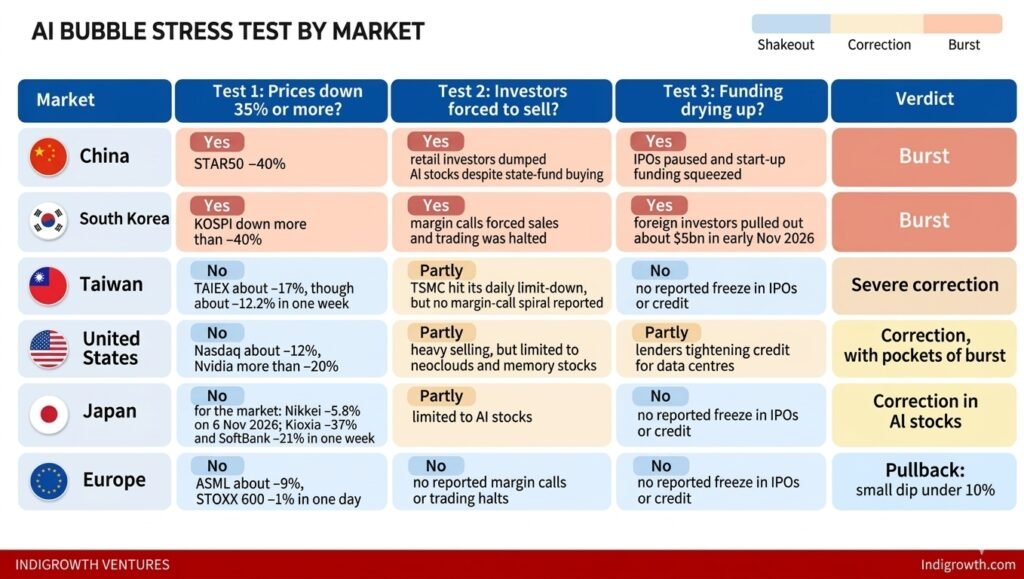
The US decides whether this becomes global. AI-linked stocks are about 49% of the S&P 500’s value, more than China’s 42% before its crash [14]. So far US losses are concentrated in the most leveraged names, not the cash-rich platforms. A dissenting view exists even for China: state media argue the pullback is not a burst [19].
WHAT THE FUTURE LOOKS LIKE
Our base case is a contained correction: AI valuations and financing reset, while AI demand keeps growing. Gartner still expects AI infrastructure spending to rise from $1.43tn in 2026 to $1.89tn in 2027[22]. What is being repriced is how that spending is funded and who earns a return on it, not whether it happens.
The money doesn’t vanish; it rotates. Investors are already moving from AI-heavy markets to “non-AI” ones. Foreign investors put about $5.7bn (₹53,739 crore) into Indian equities between 2 and 9 November 2026, reversing two months of outflows [23]. Jefferies called the 5 November 2026 sell-off “reactionary, not a fundamental reset” [24].
Wall Street’s leaders are taking the long view. Goldman Sachs CEO David Solomon said on 9 November 2026 that there is “still very strong demand for investments in the AI infrastructure build”. He said Goldman had been very active in AI capital-markets deals in recent weeks and expects that activity to continue over the next two months, even as investors recalibrate around AI spending and returns [25]. JPMorgan analysts are similarly constructive. After the sell-off, they see an attractive balance of risk and reward in hyperscaler stocks and believe the group has “room to re-rate higher over the medium term”. Strategists also expect tougher regulation to slow data-centre construction, with the biggest risk falling on highly leveraged neoclouds rather than established players [26].
WHAT CIOs SHOULD DO NOW?
Don’t pause AI; buy it better. A market correction is not a technology failure. For buyers, it shifts negotiating power from vendors to customers while raising supplier risk. Seven moves for the 2027 and 2028 budget cycles:
- Prune, don’t freeze. IT budgets are projected to grow just 3.7% in 2027. Gartner advises CIOs to eliminate “zombie” AI projects and require 90-day proof points for new AI investments [27]. Agree with the CFO in advance which initiatives to quit or redirect [28].
- Use the buyer’s market, but avoid long lock-ins. Compute pricing is wide and volatile. In October 2026, on-demand H100 rates ran from $3.20 to $12.29 per GPU-hour across 16 providers [29], and spot capacity was listed as low as $1.25 in May 2026[30]. Favour shorter terms, price-review clauses and consumption flexibility over multi-year take-or-pay commitments.
- Stress-test vendor viability. Neoclouds and AI start-ups that relied on open equity and credit markets are most exposed: CoreWeave is about 56% below its 2026 high [17], and regulators are scrutinising data-centre lending [16]. Ask for financial disclosures, escrow of models and data, change-of-control rights and tested exit plans. Gartner’s advice is blunt: “watch your partners” [22].
- Build optionality across chips, models and clouds. Nvidia’s leadership change [21] is a reminder of single-supplier risk, and rivals AMD and Broadcom gained on the news [3]. Abstraction layers, multi-model routing and open-weight options keep workloads portable if a supplier stumble.
- Plan for policy-driven capacity risk. From January 2027, US rules on data-centre power and electricity costs are likely to tighten [31]. Secure capacity across regions and check energy pass-through clauses in hosting and cloud contracts.
- Fund the foundations, not just the visible AI line items. Gartner warns CIOs against overfunding visible AI budget items at the expense of the data, security and operations they depend on [32].
- Reprice your partners’ AI promises. Systems integrators and managed-service providers are pitching AI-led deals into a falling market. Push for outcome-based pricing, and test their productivity claims against independent market research before signing multi-year renewals.
THE TAKEAWAY
The AI bubble has burst where it was most speculative, not where it was most profitable. China and South Korea show what a full unwind looks like. The US is repricing its most indebted AI names first. For technology leaders, this is a window to lock in better terms, harden supplier risk and fund AI on proof rather than promise.
Understand Issues. Remove Guesswork. Embed Insights
- Hokanews (Coin Bureau data): AI Stocks Lose $13.2 Trillion in Market Value as Six Tech Giants Slide From 2026 Highs, 8 Nov 2026;
https://www.hokanews.com/2026/11/ai-stocks-lose-132-trillion-in-market.html - 24/7 Wall St.: Older Nvidia Chips Just Cost Oracle Its Microsoft AI Deal, 7 Nov 2026,
https://247wallst.com/investing/2026/11/07/older-nvidia-chips-just-cost-oracle-its-microsoft-ai-deal/ - Reuters (via Kitco): Global AI stocks sink as Nvidia CEO’s exit deepens sector concerns, 12 Nov 2026,
https://www.kitco.com/news/off-the-wire/2026-11-12/global-ai-stocks-sink-nvidia-ceos-exit-deepens-sector-concerns - Crypto Briefing: AI stocks erase $13.2 trillion in market value as selloff deepens, 7 Nov 2026
https://cryptobriefing.com/ai-stocks-erase-13-trillion-selloff/ - YourStory: AI stocks crash wipes $2.5 trillion off Wall Street, 6 Nov 2026
https://yourstory.com/ai-story/ai-stocks-crash-wall-street-trillion-rout - YourStory: AI stocks crash wipes $2.5 trillion off Wall Street, 6 Nov 2026
https://protos.com/kospi-erases-an-entire-years-worth-of-south-korean-gdp/ - NewsBytes: South Korea’s KOSPI and Taiwan’s TAIEX plunge on AI doubts, Nov 2026,
https://www.newsbytesapp.com/news/business/south-koreas-kospi-and-taiwans-taiex-plunge-on-ai-doubts/tldr - Business Today: India reclaims fifth spot in global market cap rankings as FII inflows rise, Brent crude falls, 12 Nov 2026,
https://businesstoday.in/markets/stocks/story/india-reclaims-fifth-spot-in-global-market-cap-rankings-as-fii-inflows-rise-brent-crude-falls-567013-2026-11-12 - Reuters (via Euronext): In China, the AI bubble has already burst, 26 Oct 2026,
https://live.euronext.com/en/financial-news/china-ai-bubble-has-already-burst - Nikkei Asia (via Digg): Kioxia’s market value falls roughly two-thirds from its June 2026 peak, 2026,
https://digg.com/world-business/xzx9v65b - CEPA: Midterm Fallout: AI and Data Centers Take Center Stage, 9 Nov 2026,
https://cepa.org/?p=59893 - TNND (via KMPH): AI industry faces new political reality after Democratic gains in midterms, Nov 2026,
https://kmph.com/news/nation-world/ai-industry-faces-new-political-reality-after-democratic-gains-in-midterms-data-centers-moratorium-regulations - Vested Finance: Are we in an AI crash? What the midterm sell-off is really telling us, 6 Nov 2026,
https://vestedfinance.com/blog/us-stocks/are-we-in-an-ai-crash-what-the-midterm-sell-off-is-really-telling-us/ - International Finance: IF Insights: China’s AI bubble bursts, leaving a lesson for Wall Street, Nov 2026,
https://internationalfinance.com/markets/if-insights-chinas-ai-bubble-bursts-leaving-a-lesson-for-wall-street/ - FourWeekMBA: BoE’s Bailey Says AI Bubble Risk Exists: ‘Remember Netscape’, Nov 2026,
https://fourweekmba.com/ai-boes-bailey-says-ai-bubble-risk-exists-remember-netscape/ - FourWeekMBA: BoE Probes Tenantless Data Centre Loans; $1.75T Debt Seen, Nov 2026,
https://fourweekmba.com/ai-boe-probes-tenantless-data-centre-loans-1-75t-debt-seen/ - Yahoo Finance: What Happens to the AI Boom Now That Nvidia CEO Jensen Huang Is Gone?, 12 Nov 2026,
https://finance.yahoo.com/technology/ai/articles/happens-ai-boom-now-nvidia-172133676.html - Crypto Briefing: South Korean stocks crater as chipmaker selloff erases months of AI gains, Nov 2026,
https://cryptobriefing.com/south-korean-stocks-chipmaker-selloff/ - Corp-Intl: Has China’s AI bubble burst? STAR50 down 40%, $480bn gone, Nov 2026,
https://corp-intl.com/news/has-chinas-ai-bubble-burst-star50-480bn - TIKR: ASML Sinks 8% as Post-Election Chip Rout Deepens, 5 Nov 2026,
https://www.tikr.com/blog/asml-sinks-8-as-post-election-chip-rout-deepens - NVIDIA (SEC Form 8-K): NVIDIA Announces CEO Transition, 12 Nov 2026,
https://www.sec.gov/Archives/edgar/data/0001045810/000104581026000082/nvidiaannouncesceotransiti.htm - BERI: Gartner: 2026 Is When the AI Garden Gets Pruned, 22 May 2026,
https://www.beri.net/article/2026-05-22-gartner-pruning-ai-garden-vendor-shakeup - Free Press Journal: FPIs Pump ₹53,739 Crore Into Indian Equities, AI Sell-Off Sparks Buying Spree In November, 10 Nov 2026,
https://www.freepressjournal.in/business/fpis-pump-53739-crore-into-indian-equities-ai-sell-off-sparks-buying-spree-in-november - Aiera: Did the AI Bubble Just Pop? The 5 November 2026 Rout Explained, Nov 2026,
https://aiera.blog/?p=3403 - CNBC: Goldman CEO Solomon says AI financing remains strong despite market jitters, 9 Nov 2026,
https://www.cnbc.com/2026/11/09/goldman-ceo-ai-financing-market.html - Morningstar: What’s Next for the AI Stock Trade After the Midterms?, 12 Nov 2026,
https://www.morningstar.com/stocks/whats-next-ai-trade-after-midterms - Gartner: CIO Planning for 2027: Close the AI Ambition Gap, 31 Aug 2026,
https://www.gartner.com/en/articles/cio-planning-for-2027 - Gartner: Bridging the AI Trough: 3 Gaps to Close for the 2027 CIO and Technology Executive Agenda, 12 Oct 2026,
https://www.gartner.com/en/documents/8497877 - Uvik Software: GPU Price Index 2026: NVIDIA H100, H200, B200 and AMD MI300X Prices to Rent and Buy, Oct 2026,
https://uvik.net/blog/gpu-price-index/ - Emma: The NVIDIA H100 in 2026: A 12× Price Spread for the Same Silicon, 18 May 2026,
https://www.emma.ms/blog/nvidia-h100-cloud-gpu - Techstrong.ai: Democrats Prepare Sweeping Crackdown on AI Data Centers Following Midterm Victories, Nov 2026,
https://techstrong.ai/articles/democrats-prepare-sweeping-crackdown-on-ai-data-centers-following-midterm-victories/ - Gartner: Avoid the AI Budget Trap: 4 Steps for CIOs Planning 2027 through 2028 IT Investments, 6 Aug 2026,
https://www.gartner.com/en/documents/8234693 - Startup Fortune: China’s AI bubble is bursting, and a funding crisis now threatens smaller tech players, Nov 2026,
https://startupfortune.com/chinas-ai-bubble-is-bursting-and-a-funding-crisis-now-threatens-smaller-tech-players/ - GNCrypto News: Heavy selling hits Korea, Taiwan as global funds cut Asia AI risk, Nov 2026,
https://www.gncrypto.news/news/ai-valuation-worries-drive-tech-outflows-in-taiwan-korea/ - Trading Economics: TAIEX Ends at Over 6-Month Low, Posts 4th Weekly Loss, 6 Nov 2026,
https://tradingeconomics.com/taiwan/stock-market/news/598961 - FourWeekMBA: TSMC Opens Limit-Down as Taiwan’s AI Stocks Lose $182B, 6 Nov 2026,
https://fourweekmba.com/ai-tsmc-opens-limit-down-as-taiwans-ai-stocks-lose-182b/ - Trading Economics: Japanese Share Decline on Tech Selloff, Nov 2026,
https://tradingeconomics.com/japan/stock-market/news/597974 - FourWeekMBA: ASML Ends Up 2.4% as DAX Falls 2%; 4 of 5 Europe Chips Gain, 6 Nov 2026,
https://fourweekmba.com/ai-asml-ends-up-2-4-as-dax-falls-2-4-of-5-europe-chips-gain/ - Trading Economics: Yen Weakens Despite Hawkish BOJ Outlook, 10 Nov 2026,
https://tradingeconomics.com/japan/currency/news/599801 - Trading Economics: Offshore Yuan Holds Firm, 10 Nov 2026,
https://tradingeconomics.com/china/currency/news/599807 - HDFC Sky (PTI): INR vs USD Rate, November 9, 2026: Rupee Rises 5 Paise To Close at 93.93 Against US Dollar, 9 Nov 2026,
https://hdfcsky.com/news/rupee-rises-5-paise-to-close-at-93-93-against-us-dollar

