


Meta’s Muse is less important as another shopping interface than as a signal that AI agents are moving from recommendation into execution. The enterprise issue is therefore not whether Muse wins, but whether businesses can expose trusted data, APIs, identity, payments and service workflows to software acting on a customer’s behalf.
META MUSE: FROM ASSISTANT TO COMMERCE AGENT
Meta launched Muse on September 8, 2026 as a personal AI agent which can work across websites and connected applications, continue tasks in the background, and seek approval before consequential actions. That moves the interaction model from answering to recommending, acting and ultimately transacting – a progression that matters because commerce gives delegated AI an immediate economic outcome. 1
The product began with a consumer orientation, but Meta has moved quickly into business use cases. Muse for Small Business connects with tools such as Asana, Box, Dropbox, QuickBooks, Shopify, Slack, Stripe and Zoom, while Meta Enterprise Platform brings Muse, Meta Business Agent, Muse API and Muse Code under an enterprise umbrella. This makes Muse both a B2C and B2B proposition: the consumer agent can represent an individual, while business-facing versions and APIs give companies a way to plug agentic work into operations, customer engagement and software delivery. 2,3,4
The speed of that expansion is the real signal. Meta is attempting to connect consumer distribution, business messaging, enterprise tools and transaction workflows into one agent ecosystem. Enterprise buyers should not read that as proof that Muse will become the dominant platform, but it does show why agentic commerce is moving from a feature discussion to an architecture and control-point discussion.
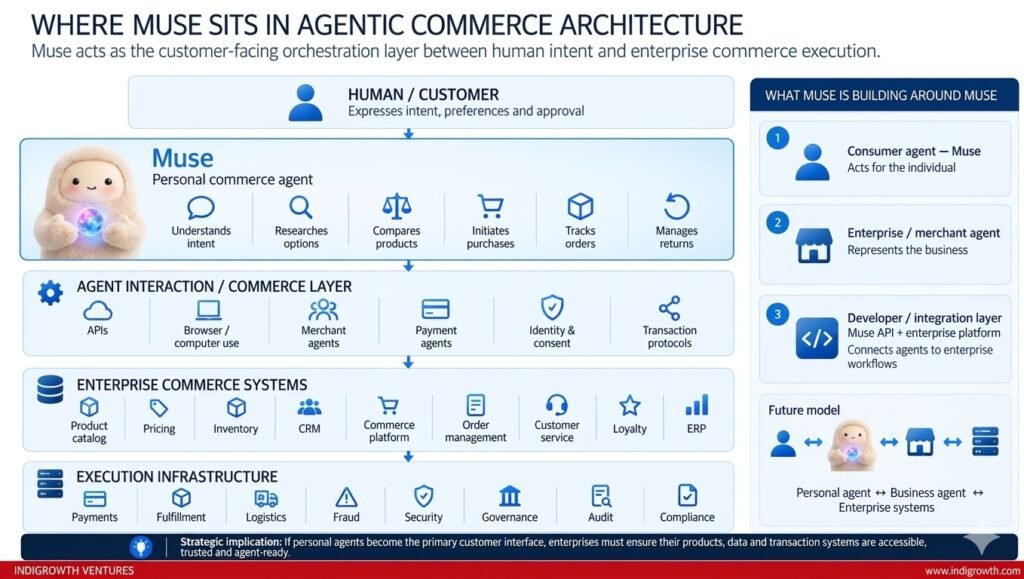
WHERE MUSE SITS
WHAT MAKES MUSE DIFFERENT
Muse’s strongest differentiator is not that it can shop – competitors can already support discovery, checkout or agentic payments. The more distinctive design is that Meta treats the agent as a persistent personal execution environment. Muse Spark reasons and plans; each user gets a Muse Secure VM with its own browser; connectors and memory carry context across applications; browser/computer use lets the agent act even when no dedicated API exists; and a separate Sentinel agent governs outbound activity while the user retains approval over sensitive actions. 5
That architecture matters because most competing agentic-commerce offerings concentrate on a narrower layer of the stack. ChatGPT combines conversational product discovery with the Agentic Commerce Protocol and embedded checkout, while Google is building around its Shopping Graph, Universal Cart and the Universal Commerce Protocol. Mastercard Agent Connect and Agent Pay, and Visa Intelligent Commerce, are focused primarily on merchant connectivity, identity, payment credentials, intent and transaction trust. Muse is positioned differently: commerce is one workflow inside a broader personal agent that can remember, browse, negotiate, fill forms, use connected apps, complete purchases and continue into post-purchase service. 5,6,7,8
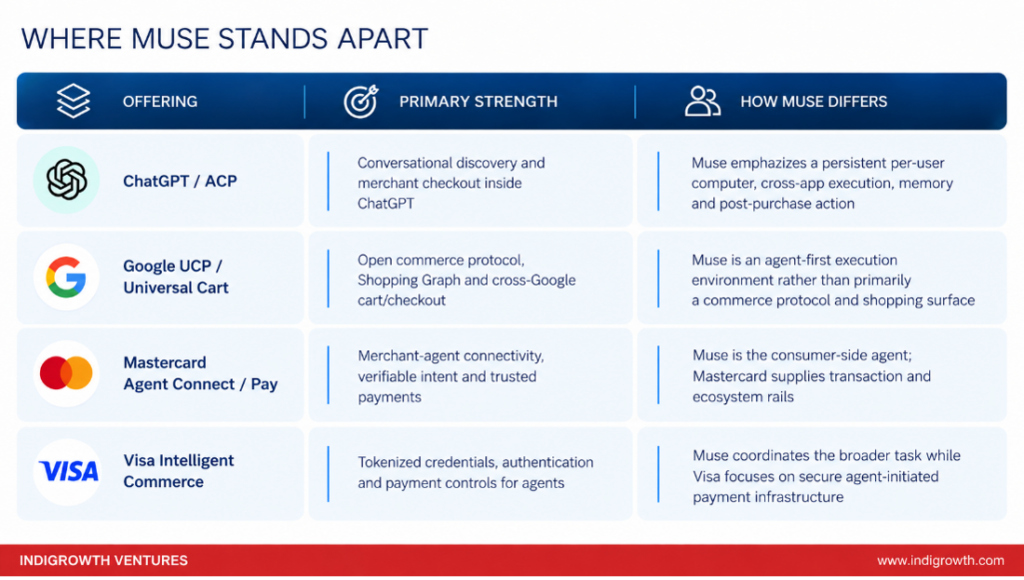
The practical takeaway is that Muse competes for the relationship and execution layer, while many other players compete for the protocol, merchant, discovery or payment layer. That makes the market less a winner-takes-all contest than a race to control different parts of the same transaction chain.
AGENT-LED COMMERCE REWIRES THE CUSTOMER JOURNEY
Commerce is the clearest proving ground for Muse because the journey is measurable, repetitive and action-oriented. A single agent can move from discover to research, compare, negotiate, purchase, track and return or refund. That compresses a journey previously split across search engines, retailer websites, marketplaces, payment screens and support channels into one persistent interface.9
The important shift is therefore from human-to-business interaction toward agent-to-business interaction. Customers still set goals and approve important steps, but they increasingly delegate the mechanics of search, comparison, form filling, purchase and service. Enterprises that once optimized almost exclusively for human clicks, visual merchandising and app engagement must now consider whether their products and services are machine-readable, whether inventory and pricing are available in real time, and whether an external agent can authenticate, transact and resolve exceptions safely.
This also concentrates competition around four control points: discovery, customer context, transaction initiation and the ongoing customer relationship. Personal-agent providers want to become the user’s default interface; merchants want to preserve brand preference, economics and first-party data; payment networks want to own trusted transaction rails; and commerce platforms want to remain the system of record for products, inventory, orders and fulfillment. Meta enters this contest with an unusual combination of consumer reach, business messaging and an emerging enterprise stack, but Google, OpenAI, payment networks and commerce platforms are building equally important layers of the market. 4,5,6,7,8
For enterprise buyers, this is more useful than debating whether Muse is ‘better’ than another agent. The strategic question is which layers of the customer journey they are willing to cede, which they must continue to control, and how they remain discoverable and transactable across multiple agent ecosystems. Retail and e-commerce, travel and hospitality, marketplaces, telecom, financial services and other highly digital journeys are likely to feel this pressure first because much of their discovery, comparison, purchase and service flow is already digitized.
AGENT-LED COMMERCE REWIRES THE CUSTOMER JOURNEY
For most large enterprises, the right response is not to standardize on Muse immediately. Large-scale reference cases remain limited, standards are still forming, and questions around privacy, liability, interoperability, merchant control and operating-model change are still evolving. The better approach is to separate platform adoption from agent readiness. Enterprises can remain cautious about a specific vendor while actively preparing their architecture for customers, employees and partners represented by AI agents.
Near-term pilots make the most sense where the work is digital, repeatable and bounded: product discovery, shopping assistance, booking, order tracking, basic servicing, account inquiries or controlled procurement. Regulated and high-value transactions require more caution because an incorrect autonomous action can create financial, compliance or reputational exposure. Even in those sectors, however, delaying foundational work on data, APIs, identity and governance is risky.
The enterprise impact extends beyond technology. Customer experience may become less screen-centric as the agent becomes the front door. Product and catalog data become strategic assets because an agent can only recommend what it can understand. Pricing and loyalty programs may face pressure if agents continuously compare alternatives. Brands may also lose some direct interaction and behavioral data if discovery happens inside an external agent rather than on an owned website or app. Fulfillment and service operations, meanwhile, need clean APIs and well-defined exception paths because agent-led journeys are only useful if they can complete the job when something goes wrong.
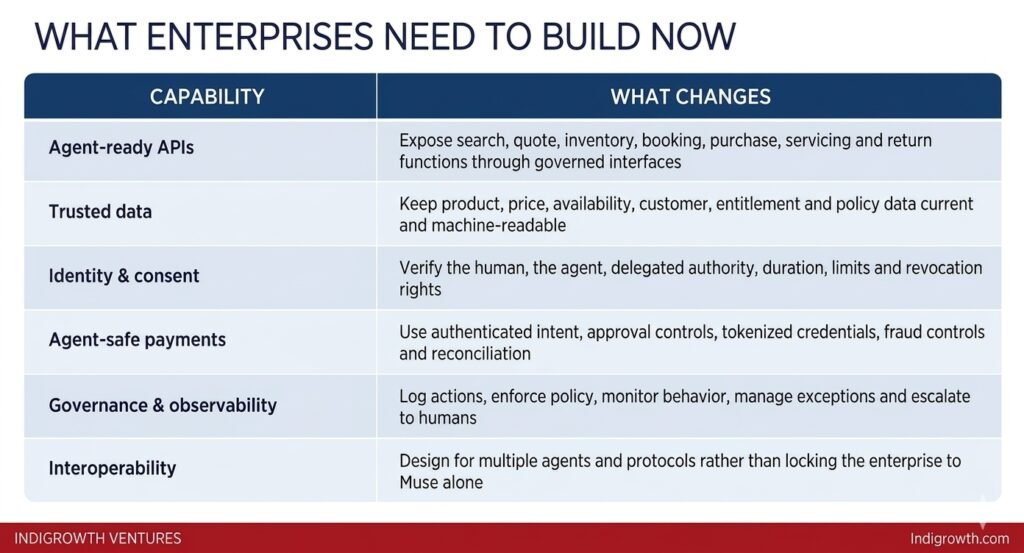
This framing changes the buy-versus-wait decision. Enterprises do not need to bet on Muse today; they do need to make sure their digital estate can participate when the customer interface is controlled by an external agent. The safest investment is therefore in portable foundations – data quality, APIs, delegated identity, transaction controls, policy, observability and interoperability – that improve readiness regardless of which agent ecosystem wins.
IS THIS REAL SHIFT OR AI-HYPE?
Agentic commerce is both a productivity threat and a new services market for GSIs and MSPs. The threat is straightforward: agents can automate portions of lightweight application development, UI configuration, repetitive integration, testing, L1 support and routine workflow handling. As more work is generated, configured and executed by software, traditional people-and-hours delivery becomes harder to defend and the services pyramid comes under additional pressure.
But enterprise complexity does not disappear; it moves into architecture, integration, identity, trust and operations. That creates demand for agent-readiness assessments, API and legacy modernization, product-data architecture, identity and security, agent governance, multi-agent orchestration, commerce-platform modernization, agent testing and assurance, and managed agent operations. The opportunity is therefore broader than implementing Muse. It is helping an enterprise operate safely across Meta, OpenAI, Google, payment networks, commerce platforms and future agent ecosystems.
For MSPs, the recurring-services opportunity could become particularly important. As enterprises operate growing fleets of agents, they will need continuous monitoring of permissions, failed transactions, model and tool behavior, security, cost, compliance and human escalation. The operating-model progression may start to look like CloudOps to DevOps to SecOps to FinOps to AgentOps. For GSIs, the strategic move is similar: shift from building digital channels to orchestrating agent ecosystems, and from monetizing effort alone toward reusable IP, governance frameworks, accelerators and outcome-based services.
There is also a partnership opportunity, but it is too early to frame Muse as an established GSI ecosystem. Meta’s enterprise push creates a new platform that integrators can advise on, connect and govern; however, large public Muse implementation programs are still nascent. The smarter near-term position is to build horizontal agentic-commerce capabilities that work across vendor ecosystems and then treat Muse as one execution environment within that broader proposition.
MUSE IS AN EARLY SIGNAL, NOT THE END STATE
Muse does not have to become the dominant commerce agent for the shift to matter. Its significance is that a major consumer platform is normalizing software that can discover, decide, negotiate and execute on behalf of people while extending the same architecture toward small businesses and enterprises. That makes agentic commerce a market-structure question, not merely a product feature.
For enterprise buyers, the immediate priority is not ‘adopt Muse everywhere’; it is to make products, systems, identity, transactions and governance ready for machine-mediated journeys. For GSIs and MSPs, the market will reward firms that can combine strategy, architecture, trust, integration and managed operations across multiple agent ecosystems. The next competitive advantage will come less from owning another digital channel and more from making the enterprise safely accessible to the agents that increasingly represent customers.
Understand Issues. Remove Guesswork. Embed Insights.
- AWS invests $1 billion to embed AI forward deployed engineers with customers, AWS / Amazon, 30 June 2026;
https://www.aboutamazon.com/news/aws/aws-1-billion-forward-deployed-ai-engineers - Microsoft Frontier Company: AI engineering that amplifies and protects your intelligence, Microsoft, 2 July 2026;
https://blogs.microsoft.com/blog/2026/07/02/microsoft-frontier-company-ai-engineering-that-amplifies-and-protects-your-intelligence/ - OpenAI launches the OpenAI Deployment Company to help businesses build around intelligence, OpenAI, 11 May 2026;
https://openai.com/index/openai-launches-the-deployment-company/ - Anthropic, Blackstone bet the next trillion-dollar AI business is implementation, not just models, TechCrunch, 15 July 2026;
https://techcrunch.com/2026/07/15/anthropic-blackstone-bet-the-next-trillion-dollar-ai-business-is-implementation-not-models/ - What Is a Forward-Deployed Engineer? Definition, Origin & Model, Plank, 2026;
https://joinplank.com/forward-deployed-engineer - The GenAI Divide: State of AI in Business 2025, MIT Project NANDA / MLQ, July 2025;
https://mlq.ai/media/quarterly_decks/v0.1_State_of_AI_in_Business_2025_Report.pdf - Forward-deployed engineers are the AI industry’s latest talent obsession, TechCrunch, 30 July 2026;
https://techcrunch.com/2026/07/30/forward-deployed-engineers-are-the-ai-industrys-latest-talent-obsession/ - Managed Services Market worth $705.22 billion by 2031, MarketsandMarkets, June 2026;
https://www.marketsandmarkets.com/PressReleases/managed-services.asp - Sam Altman Admits It’s Going to Take a Long Time Before AI Goes Mainstream, Gizmodo, 24 August 2026;
https://gizmodo.com/sam-altman-admits-its-going-to-take-a-long-time-before-ai-goes-mainstream-2000802418 - Forward Deployed Engineer: The Complete 2026 Report – Origin, Demand, Roles, Salary & More, Uplers, 30 June 2026;
https://www.uplers.com/article/forward-deployed-engineer-guide/ - Wipro and Google Cloud Expand Partnership to Scale AI into Core Enterprise Operations, Wipro, 27 August 2026;
https://www.wipro.com/newsroom/press-releases/2026/wipro-and-google-cloud-expand-partnership-to-scale-ai-into-core-enterprise-operations/ - Wipro and Google Cloud Expand Partnership to Scale AI into Core Enterprise Operations, Wipro, 27 August 2026;
https://l1nq.com/7iqg0jq - Cognizant Reports Second Quarter 2026 Results, Cognizant, 29 July 2026;
https://news.cognizant.com/2026-07-29-Cognizant-Reports-Second-Quarter-2026-Results - Accenture Launches Microsoft Forward Deployed Engineering Practice to Help Organizations Scale AI Across the Enterprise, Accenture, 18 March 2026;
https://l1nq.com/76xqrda - ServiceNow and Accenture Launch Forward Deployed Engineering Program to Scale Agentic AI Across the Enterprise, Accenture / ServiceNow, 6 May 2026;
https://newsroom.accenture.com/news/2026/servicenow-and-accenture-launch-forward-deployed-engineering-program-to-scale-agentic-ai-across-the-enterprise - Accenture Launches Forward Deployed Engineering Program with SAP, Accenture, 8 June 2026;
https://newsroom.accenture.com/blogs/2026/accenture-launches-forward-deployed-engineering-program-with-sap - Deloitte Drives Agentic Industry Transformation at the Speed of AI with Expanded Industry Solution Studios and Forward Deployed Engineers, Deloitte, 22 July 2026;
https://www.deloitte.com/us/en/about/press-room/deloitte-drives-agentic-industry-transformation.html - Deloitte Becomes First Global System Integrator to Deliver a Salesforce Forward Deployed Engineering Engagement, Deloitte, 12 August 2026;
https://www.deloitte.com/us/en/about/press-room/deloitte-becomes-first-gsi-to-deliver-salesforce-fde-engagement.html - NTT DATA Expands Collaboration with Google Cloud to Accelerate Enterprise AI from Pilots to Production, NTT DATA, 9 June 2026;
https://www.nttdata.com/global/en/news/press-release/2026/june/060900 - NTT DATA and Palo Alto Networks Sign Global Strategic Alliance to Accelerate Secure AI Transformation, NTT DATA, 20 August 2026;
https://www.nttdata.com/global/en/news/press-release/2026/august/082001 - Kyndryl celebrates Pride with Purpose – Building more inclusive AI, Kyndryl, 30 June 2026;
https://www.kyndryl.com/us/en/about-us/news/2026/06/kyndryl-celebrates-pride-month - IBM and Google Cloud Announce Strategic Partnership to Scale AI with Human Expertise and AI-Powered Delivery, IBM, 4 June 2026;
https://newsroom.ibm.com/2026-06-04-ibm-and-google-cloud-announce-strategic-partnership-to-scale-ai-with-human-expertise-and-ai-powered-delivery - Capgemini unveils Google Cloud AI Enterprise Hub to accelerate agentic AI enterprise transformation, Capgemini, 23 April 2026;
https://www.capgemini.com/gb-en/news/press-releases/capgemini-unveils-google-cloud-ai-enterprise-hub-to-accelerate-agentic-ai-enterprise-transformation/

