

The next cybersecurity platform is not another dashboard. It is a continuously learning decision-and-action layer that understands the enterprise, predicts the attacker’s next move and contains risk at machine speed with humans still accountable for the outcome. Competitive edge now lies in governed, context-aware action at machine speed. This market research examines the shift through a 2026 cybersecurity Market Insights lens
A THREAT LANDSCPE THAT NO LONGER PLAYS BY HUMAN RULES

Over the past year, AI has moved from being a productivity tool at the edge of the enterprise to becoming part of its operating core. Organizations are deploying copilots, AI models and autonomous agents across software development, customer service, finance and IT operations. Each deployment introduces a new class of assets – prompts, models, vector databases, plug-ins and non-human identities – often with access to sensitive data and business systems. The attack surface no longer surrounds AI; it now includes the AI itself.
WHY AI IN CYBER DEFENCE?
What has changed in the last 12-18 months that makes AI embedding a must? Attackers are using AI to industrialize familiar techniques.
- AI is compressing the attacker’s cycle. 94% of respondents called AI the biggest driver of cybersecurity changes and 87% said AI-related vulnerabilities were the fastest-growing cyber risk during 2025, as per World Economic Forum’s 2026 outlook
- The share of organizations assessing the security of their AI tools nearly doubled in one year – from 37% to 64%
- IBM found attackers used AI in 16% of studied breaches, most often for AI-generated phishing and deepfake impersonation
McKinsey warns that attack breakout times are often under an hour, outpacing manually driven security operations.5 This acceleration is colliding with an already fragmented technology estate. Cloud did not replace legacy infrastructure; it added identities, SaaS applications, APIs, containers and data spread across multiple clouds and on-premise systems. The result is a widening speed-and-context gap
30% of breaches crossed multiple environments, costing an average of $5.05m and taking 276 days to identify and contain, as per IBM: Cost of a data breach market research report 2025
This is why embedding AI into cyber defence has become an operational necessity rather than a technology upgrade. Security teams need it to correlate signals, identify abnormal behaviour, accelerate investigations and automate containment under human-defined guardrails. The goal is not to replace analysts, but to give defenders the speed, scale and context needed to counter adversaries.
BUT HERE’s THE ADOPTION PARADOX: HIGH AWARENESS, LOW DEPLOYMENT
AI-powered defence remains more ambition than reality. BCG found that 60% of organizations believed they had faced an AI-enabled attack, but only 7% had deployed AI-based defence tools.
The AI Cyber Defense Gap
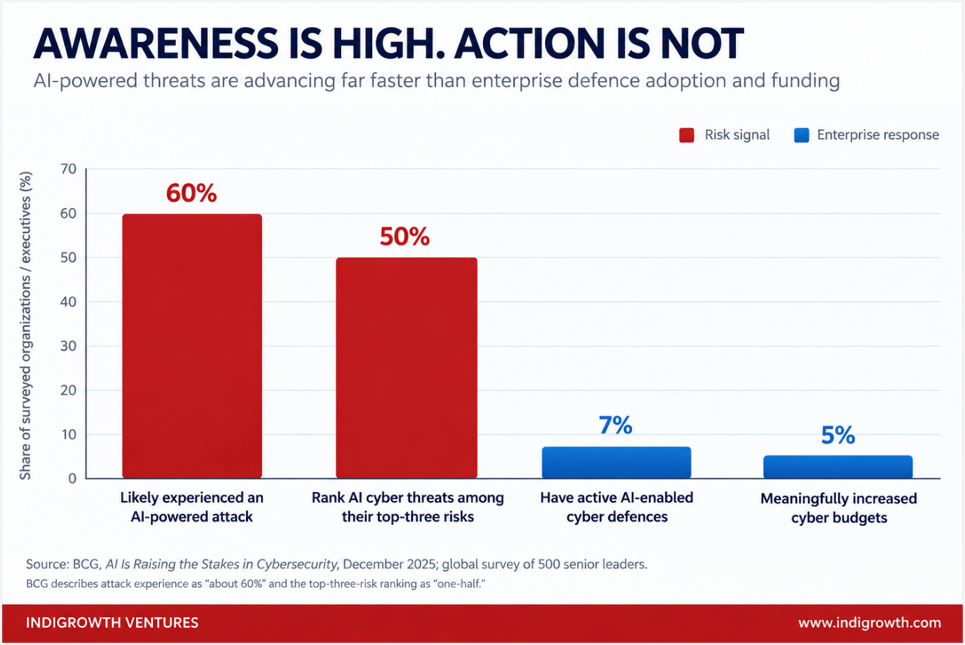
Although 88% plan to adopt them, three barriers are slowing execution:
- Skills: 69% struggle to hire AI-cybersecurity talent, according to BCG. PwC found that 50% lack knowledge of applying AI to cyber defence6
- Foundations: Fragmented data, legacy tools and weak identity controls limit the effectiveness of security AI
- Trust and funding: Concerns about false positives, data exposure and automated decisions persist. Only 5% have significantly increased cyber budgets in response to AI attacks
DELAY CAN BE RISKY AND EXPENSIVE
IBM found extensive use of AI and security automation reduced both breach cost and lifecycle.
- Saved an average $1.9M in breach costs
- Reduced the breach lifecycle by 80 days
AI environments are also targets: 97% of organizations reporting AI-related breaches lacked proper AI access controls; 60% suffered data compromise, 31% operational disruption, and shadow AI added $670,000 to average breach costs.
The practical answer is governed adoption: begin with alert triage, investigation and threat hunting while retaining human control over high-impact decisions.
EVOLUTION OF ENTERPRISE THREAT MANAGEMENT
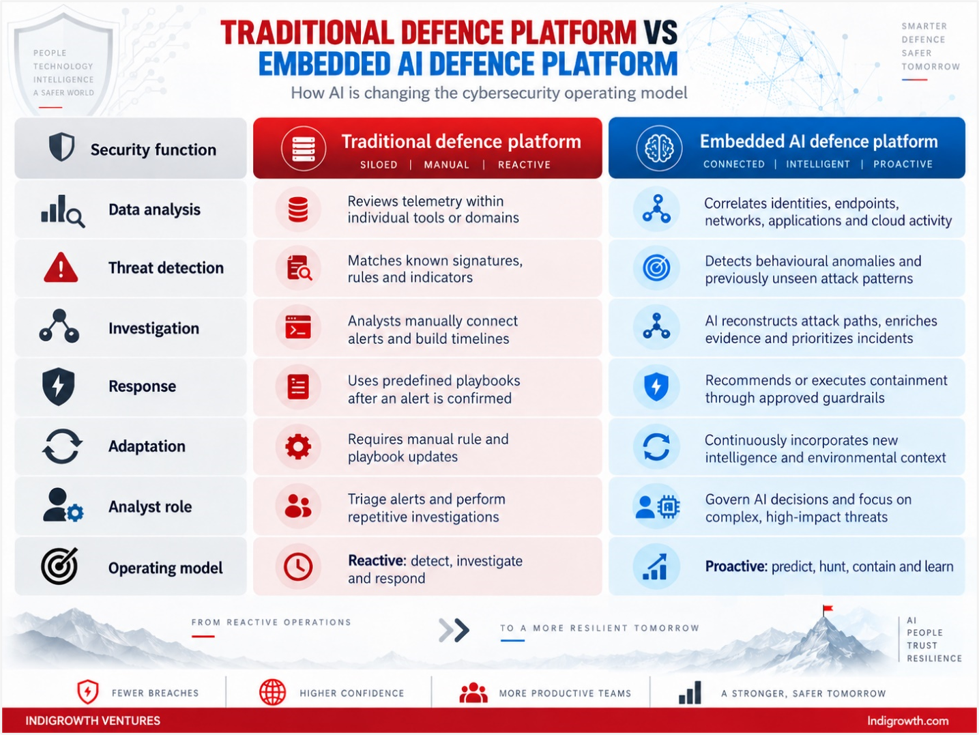
Pre-AI platforms primarily collected, matched and alerted using signatures, rules and human-written playbooks. Machine learning supported detection, but investigation and decisions remained largely analyst-led.
ARCHITECTURE OF EMBEDDED AI: FROM POINT TOOLS TO NATIVE DEFENSE
Embedded AI is not a chatbot added to a security dashboard. It is an intelligence layer built directly into enterprise security data flows. It creates a continuous defence loop:
- Sense: Correlates telemetry across tools and environments.
- Reason: Identifies abnormal behaviour, reconstructs attack paths and prioritizes risks.
- Act: Hunts threats and automates approved responses within defined guardrails.
This shifts defence from isolated tools and reactive mitigation to connected, proactive threat hunting, with analysts retaining control over policy and high-impact decisions.
MAKINGS OF AN AI-POWERED THREAT-DEFENCE PLATFORM
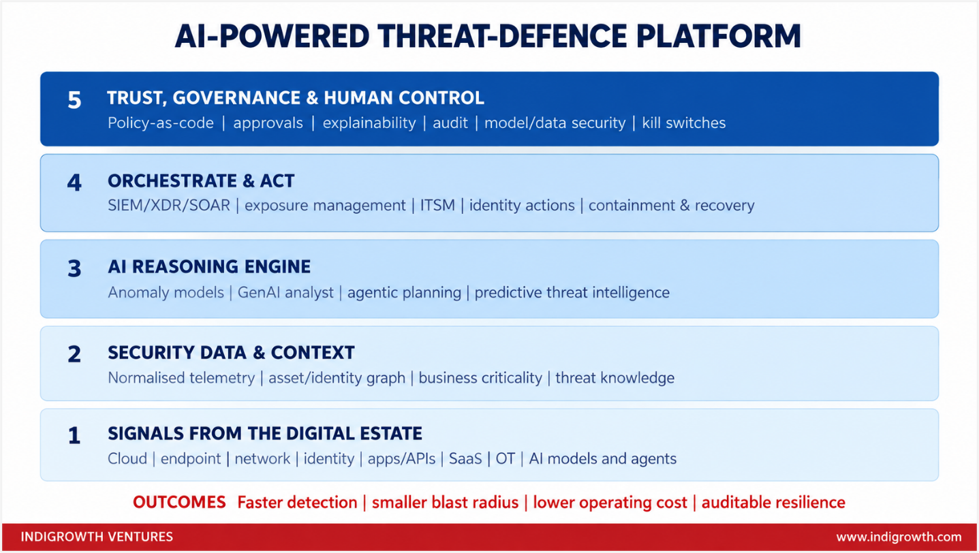
The differentiator is not the model. It is the context wrapped around the model: a current asset and identity graph, business criticality, trusted threat intelligence, policy guardrails and reversible response. Without that substrate, an AI assistant merely explains more alerts; with it, agents can investigate across tools and act within pre-approved limits.
THE FINANCIAL AND OPERATIONAL ROI OF AI-POWERED SECURITY OPERATIONS
AI-powered security operations deliver measurable value in two areas: lower breach costs and faster containment. The percentages below are calculated from IBM’s published averages.
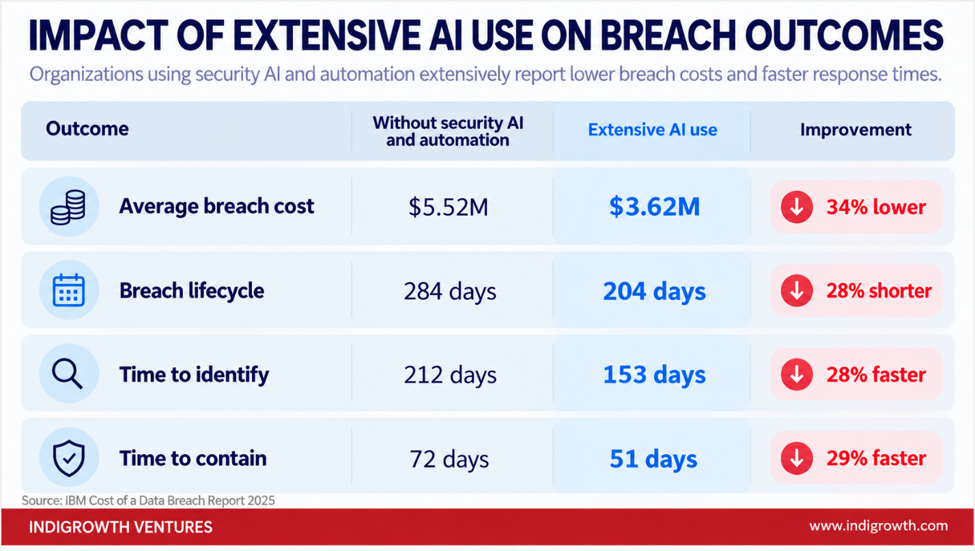
It shows that AI creates value not merely by reducing analyst workload, but by limiting the time attackers remain inside the environment – and therefore the financial impact of a breach.
WHY 2026 IS THE INFLECTION POINT
AI is not new to cybersecurity; machine learning already supports malware, fraud, spam and anomaly detection. What makes 2026 different is the simultaneous movement of spending, buyer priorities, product architecture and threat conditions.
SPENDING GOING UP – CIOs HAVE OPENED THE WALLET
- Gartner forecast 2026 information-security spending at $244B, growing to $322B by 2029, a 10% constant-currency CAGR from 2024 to 2029
- IDC expects worldwide security spending to exceed $300B during 2026, with software and managed services driving double-digit market growth and AI-driven platform adoption becoming an important source of momentum 7
PwC found 78% of organisations expected their cyber budget to rise; AI was the leading budget priority
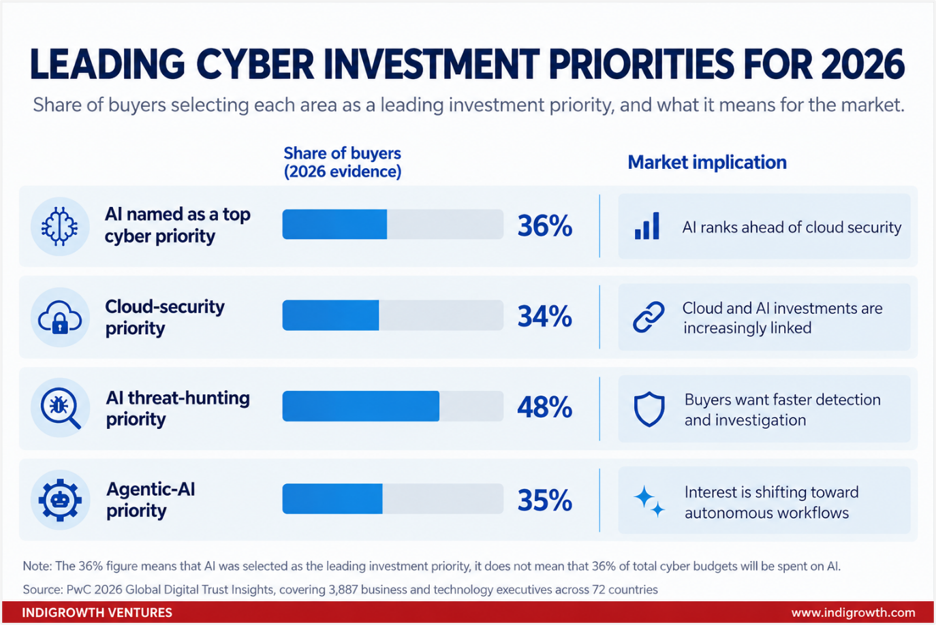
BUYERS PRIORITISING: FUNDING SPEED, CONSOLIDATION AND AUTONOMY
Buyers are trying to solve three operating problems:
- Fragmented tooling: Buyers are prioritizing AI and machine learning tools (53%), automation (48%) and tool consolidation (47%)
- Alert overload: AI can correlate, prioritize and investigate signals faster
- Skills shortages: 50% lack knowledge of applying AI to cyber defence and 41% lack relevant skills
As PwC’s Sean Joyce put it, leading organizations are investing in cyber “not just to respond, but to anticipate.” EY’s Ganesh Devarajan makes the architectural requirement equally clear: “Cyber leaders can’t just automate yesterday’s defenses.”8
THREAT CONDITION IN 2026: SPEED, IDENTITY AND AUTONOMY
The threat is no longer simply increasing in volume – it is becoming faster, more identity-driven and harder to contain
- Attack windows have collapsed. Average eCrime breakout time fell to 29 minutes, while the fastest observed intrusion moved laterally in 27 seconds. AI-enabled adversary activity increased 89% YoY, as per CrowdStrike study 9
- Cybercrime now operates like an automated supply chain. Mandiant found that the median hand-off from an initial-access broker to a follow-on attacker fell from more than eight hours in 2022 to just 22 seconds in 2025. Exploitation is also occurring, on average, seven days before a patch becomes available 10
- Identity has become the primary control plane as attackers use voice phishing, stolen session cookies, OAuth tokens and compromised SaaS integrations. Gartner warns that agentic systems are expanding identity risk from human users to machine identities and autonomous agents11
- AI is both an attacker and an attack surface. Prompt injection, malicious agent tools and compromised AI development platforms create exposure across models, data and automated workflows. IDC argues that security must therefore operate continuously across the entire AI ecosystem, not as isolated controls 12
- Ransomware has become a resilience attack. Operators are targeting backups, identity services and virtualization platforms so that organizations cannot restore operations even after containing the intrusion
What comes next
The attack surface will expand as AI becomes autonomous. Gartner expects task-specific agents to be embedded in 40% of enterprise applications by the end of 2026, up from less than 5% in 2025. 13
By 2028, Gartner14 predicts:
- 50% of enterprise incident-response efforts will involve incidents affecting custom-built AI applications.
- More than 50% of enterprises will use dedicated AI-security platforms.
- AI-security platforms will increasingly govern prompt injection, data misuse, agent identities and third-party AI services.
BCG expects the leading AI-enabled threats over the next two years to include financial fraud (43%), social engineering (39%), accelerated vulnerability discovery (28%) and adaptive malware (26%).
The inflection point is therefore not that AI has suddenly entered cybersecurity. It is that AI is simultaneously becoming a major budget priority, a native component of defence platforms and a new enterprise attack surface.
WHAT THE SHIFT MEANS FOR THE CYBERSECURITY MARKET
The rise of AI-powered threat defense platforms will reshape several parts of the industry.
PLATFORM VENDORS WILL COMPETE FOR TELEMETRY GRAVITY
Platforms with broad telemetry and control over key enforcement points gain an advantage, driving endpoint, cloud, identity, network and SIEM vendors into adjacent markets.
Forrester’s 2026 XDR evaluation included seven vendors, versus 11 in 2024 and 14 in 2021, while expanding scope into identity, cloud, threat intelligence, SIEM replacement and agentic AI. This signals concentration among providers with broad telemetry and cross-domain capabilities 15
MANAGED SECURITY SERVICES WILL BECOME AI DELIVERY VEHICLES
Many organizations do not have enough detection engineers, incident responders or AI security specialists to operate advanced platforms independently. PwC’s research indicates that organizations are increasingly using managed services to obtain AI, cloud and threat-management capabilities, particularly after experiencing a major attack16. Managed detection and response providers will therefore play a central role in operationalizing agentic security.
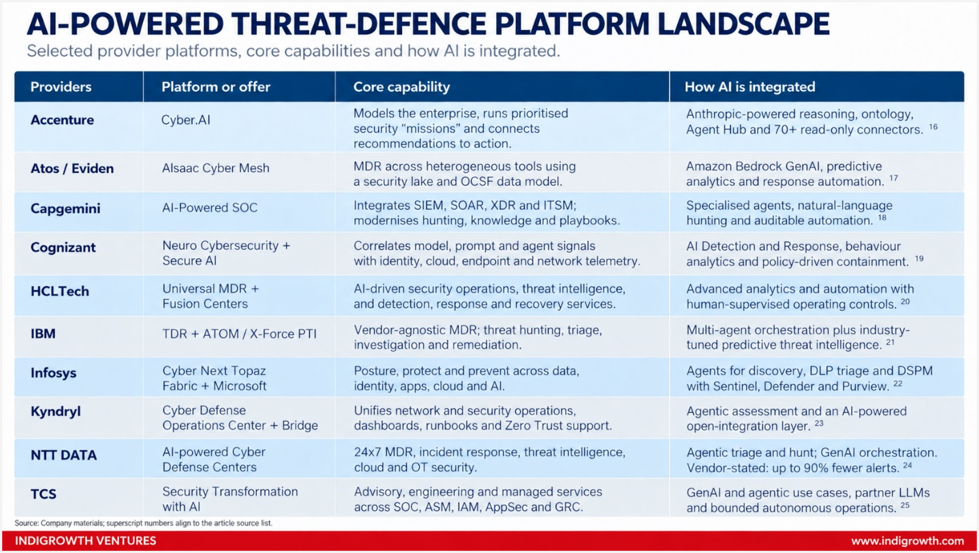
ENTERPRISE MATURITY PATH: SHIFTING FROM PILOTS TO OUTCOMES
Most enterprises will not move directly from manual security operations to an autonomous SOC. Adoption is likely to progress through four broad stages.
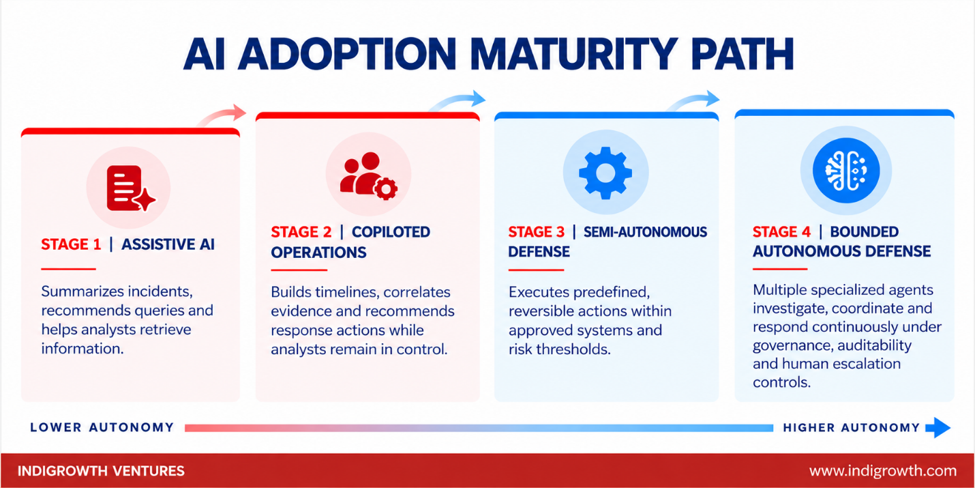
In 2026, most enterprises are moving between the second and third stages. Vendors may market autonomous capabilities, but organizational confidence, integration quality and governance maturity will determine how much operational authority customers are willing to delegate.
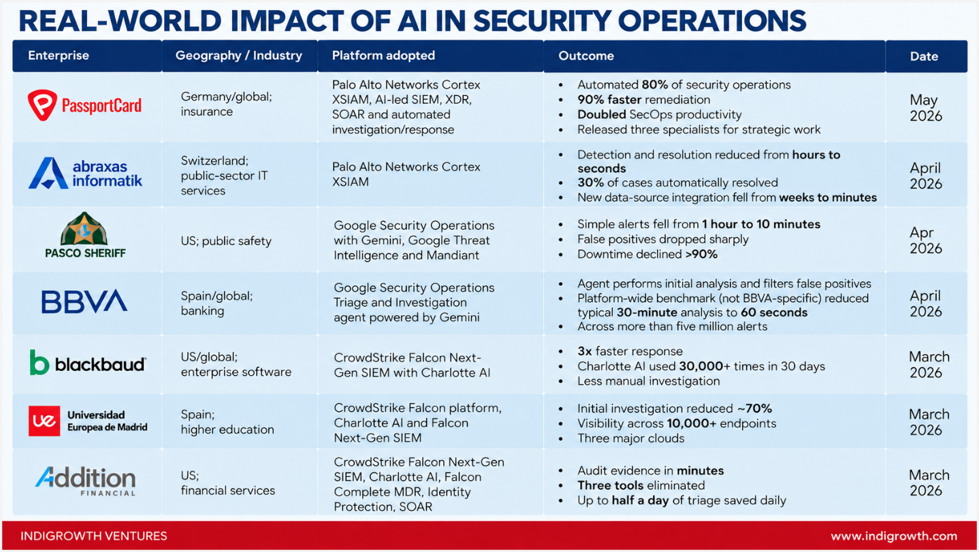
HOW MSPs AND GSIs CAN SERVE AS THE CRITICAL ENABLERS?
Enterprises often have security tools but lack the integration, specialist talent and operating model to use AI safely at scale. MSPs and GSIs close this execution gap through integration, governance and managed operations.17 The roles are complementary: GSIs design and integrate the AI-native security architecture; MSPs and MSSPs operate, monitor and continually improve it. Their advantage comes from combining cross-client threat intelligence, scarce AI-security skills and round-the-clock operations at a scale most enterprises cannot economically build alone.
WHAT THEY ARE DOING?
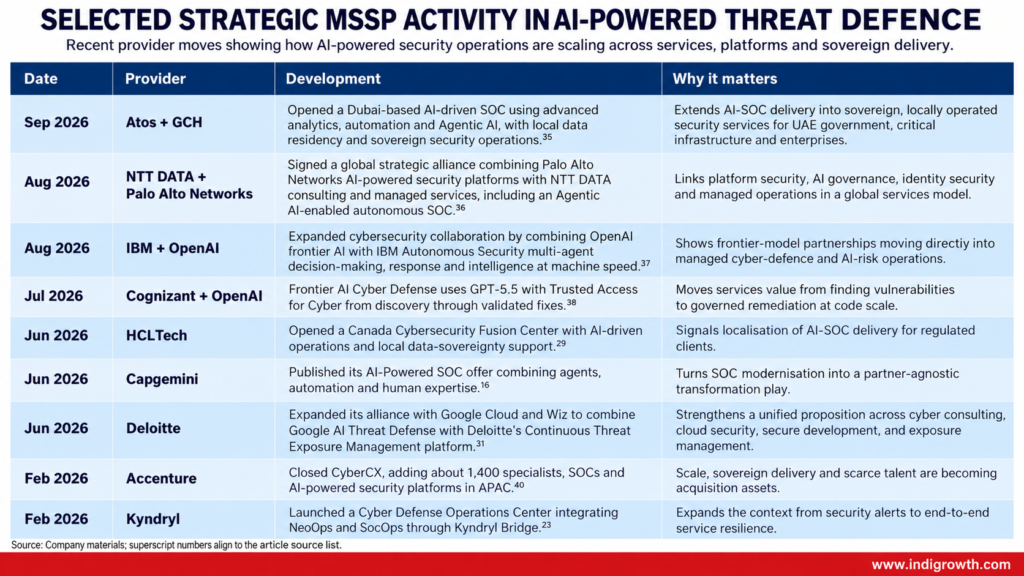
MSSPs are moving beyond alert monitoring toward AI-driven, outcome-based cyber defence. They are embedding autonomous agents across threat discovery, investigation and remediation; integrating SecOps with cloud, exposure and network operations; and expanding sovereign delivery through regional centres and acquisitions.
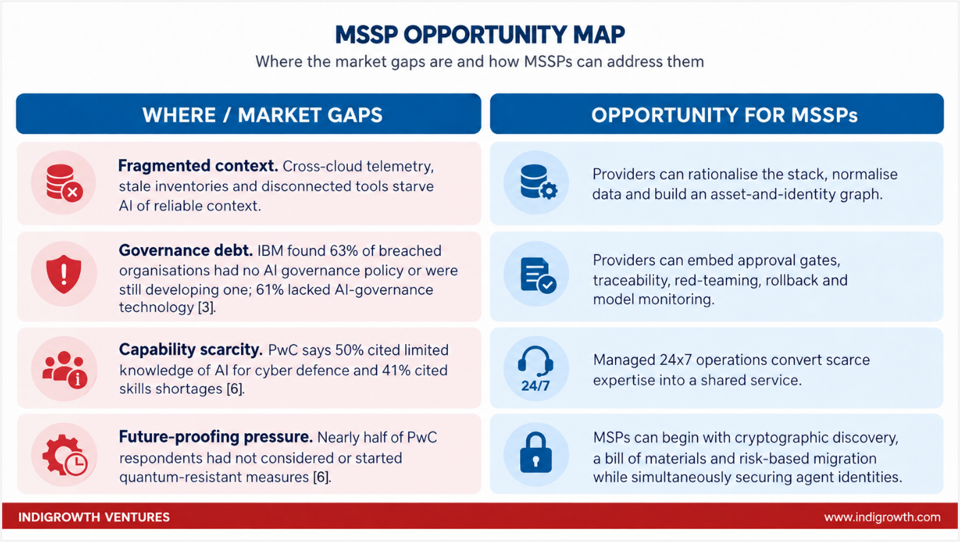
At the same time, providers are opening new managed-service opportunities in areas such as AI governance and post-quantum migration, positioning themselves as long-term operators of enterprise cyber resilience.
THE 2026 VERDICT
2026 marks the shift from AI as a security productivity aid to an operating layer for continuous detection, investigation and governed response. Adoption will advance through assistive, copiloted and bounded-autonomous operations. MSPs and GSIs will be critical to this journey, providing the integration, governance, specialist talent and 24×7 operations that most organizations cannot build independently.
Success will depend on proving outcomes: context-aware decisions, human accountability, faster containment and lower disruption. The key question is no longer whether AI belongs in cyber defence, but who can operationalize it safely before adversaries exploit the same speed advantage.
Understand Issues. Remove Guesswork. Embed Insights.
- Global Cybersecurity Outlook 2026, World Economic Forum;
https://www.weforum.org/publications/global-cybersecurity-outlook-2026/in-full/executive-summary-6efae97d74/ - Forecast: Information Security, Worldwide, 2023-2029, 3Q25 Update, Gartner;
https://www.gartner.com/en/documents/6998666 - Cost of a Data Breach Report 2025, IBM;
https://www-api.ibm.com/adobe/assets/urn:aaid:aem:607b9590-38e0-4c91-b433-aa8a17f5b5e8/original/as/cost-of-a-data-breach-2025-full-report.pdf - AI-Driven Cyber Threats Are Outpacing Defense Capabilities, BCG, 18 December 2025;
https://www.bcg.com/press/18december2025-ai-cyber-threats-outpacing-defense-capabilities - AI is the greatest threat – and defense – in cybersecurity today. Here’s why, McKinsey & Company;
https://www.mckinsey.com/about-us/new-at-mckinsey-blog/ai-is-the-greatest-threat-and-defense-in-cybersecurity-today - 2026 Global Digital Trust Insights: C-suite playbook and findings, PwC;
https://www.pwc.com/us/en/services/consulting/cybersecurity-risk-regulatory/library/global-digital-trust-insights.html - Global Security Spend to Exceed $300 Billion in 2026 as the Adoption of AI-Driven Security Platforms Gains Momentum, IDC;
https://www.idc.com/resource-center/blog/press-release-type/spending/ - Cybersecurity leaders investing in AI and agentic defenses to combat escalating AI-enabled threats, EY, March 2026;
https://www.ey.com/en_us/newsroom/2026/03/cybersecurity-leaders-investing-in-ai-and-agentic-defenses-to-combat-escalating-ai-enabled-threats - 2026 Global Threat Report, CrowdStrike;
https://www.crowdstrike.com/en-us/press-releases/2026-crowdstrike-global-threat-report/ - M-Trends 2026: Data, Insights, and Strategies From the Frontlines, Mandiant / Google Cloud;
https://cloud.google.com/blog/topics/threat-intelligence/m-trends-2026 - Strategic Focus Areas for CISOs to Seize Moments of Opportunity Among AI Chaos, Gartner, 1 June 2026;
https://www.gartner.com/en/newsroom/press-releases/2026-06-01-gartner-identifies-strategic-focus-areas-for-cisos-to-seize-moments-of-opportunity-among-ai-chaos - FutureScape 2026: Building Trust, Resilience, and Prosperity in the Agentic Future, IDC;
https://www.idc.com/resource-center/blog/futurescape-2026-building-trust-resilience-and-prosperity-in-the-agentic-future/ - Gartner Predicts 40% of Enterprise Apps Will Feature Task-Specific AI Agents by 2026, Gartner, 26 August 2025;
https://www.gartner.com/en/newsroom/press-releases/2025-08-26-gartner-predicts-40-percent-of-enterprise-apps-will-feature-task-specific-ai-agents-by-2026-up-from-less-than-5-percent-in-2025 - Gartner Predicts AI Applications Will Drive 50% of Cybersecurity Incident Response Efforts by 2028, Gartner, 17 March 2026;
https://www.gartner.com/en/newsroom/press-releases/2026-03-17-gartner-predicts-ai-applications-will-drive-50-percent-of-cybersecurity-incident-response-efforts-by-2028 - Announcing The Forrester Wave on Extended Detection And Response Platforms: Platformization, AI, And AI, Forrester;
https://www.forrester.com/blogs/announcing-the-forrester-wave-on-extended-detection-and-response-platforms-platformization-ai-and-ai/ - Cyber.AI, Accenture;
https://www.accenture.com/en/products/cyber-ai - AIsaac Cyber Mesh, Eviden / Atos;
https://pages.atos.net/aisaac-cyber-mesh.html - AI-Powered SOC, Capgemini;
https://www.capgemini.com/solutions/ai-powered-security-operations-center-soc/ - Secure AI Services, Cognizant;
https://www.cognizant.com/us/en/services/cybersecurity-services/secure-ai-services - HCLTech launches Cybersecurity Fusion Center in Mississauga, HCLTech;
https://www.hcltech.com/en-us/press-releases/hcltech-launches-cybersecurity-fusion-center-mississauga-strengthen-canadas-digital - IBM Delivers Autonomous Security Operations with Cutting-Edge Agentic AI, IBM, 28 April 2025;
https://newsroom.ibm.com/2025-04-28-ibm-delivers-autonomous-security-operations-with-cutting-edge-agentic-ai - Get Ahead of the Attacker: Building Cyber Resilience through Topaz Fabric, Infosys;
https://www.infosys.com/services/incubating-emerging-technologies/documents/get-ahead-of-the-attacker.pdf - Cyber Defense Operations Center launch, Kyndryl, February 2026;
https://www.kyndryl.com/in/en/about-us/news/2026/02/cyber-defense-operations-center-launch - Six New AI-Powered Cyber Defense Centers, NTT DATA, 2025;
https://www.nttdata.com/en-us/news/2025/ntt-data-announces-six-new-ai-powered-cyber-defense-centers - Security Transformation with AI, TCS;
https://www.tcs.com/what-we-do/services/cybersecurity/solution/tcs-security-transformation-with-ai - PassportCard doubles SecOps productivity with Cortex XSIAM, Palo Alto Networks;
https://www.paloaltonetworks.com/customers/passportcard-doubles-secops-productivity-with-cortex-xsiam - Abraxas unlocks agile AI-powered SecOps across the Swiss public sector using Cortex XSIAM, Palo Alto Networks;
https://www.paloaltonetworks.com/customers/abraxas-unlocks-agile-ai-powered-secops-across-the-swiss-public-sector-using-cortex-xsiam - Pasco Sheriff’s Office customer story, Google Cloud;
https://cloud.google.com/customers/pascosheriffsoffice - Detecting and containing threats with Google Security Operations agents, Google Cloud;
https://cloud.google.com/blog/products/identity-security/detecting-and-containing-powered-threats-with-google-security-operations-agents - Blackbaud Achieves 3x Faster Threat Response with Charlotte AI, CrowdStrike;
https://www.crowdstrike.com/en-us/resources/customer-stories/blackbaud/ - Universidad Europea de Madrid customer story, CrowdStrike;
https://www.crowdstrike.com/en-us/resources/customer-stories/universidad-europea-de-madrid/ - Addition Financial customer story, CrowdStrike;
https://www.crowdstrike.com/en-us/resources/customer-stories/addition-financial/ - Atos Partners with GCH to Open New AI-Driven Security Operations Center in the UAE, Atos and GCH, 17 September 2026;
https://atos.net/en/2026/region_exclude/middle-east_2026_09_17/atos-partners-with-gch-to-open-new-ai-driven-security-operations-center-in-the-uae - Global Strategic Alliance to Accelerate Secure AI Transformation, NTT DATA and Palo Alto Networks, 2026;
https://www.nttdata.com/en-us/news/2026/ntt-data-and-palo-alto-networks-sign-global-strategic-alliance - IBM Partners with OpenAI to Accelerate Secure AI Deployment for Enterprises Across Core Operations, IBM and OpenAI, 13 August 2026;
https://newsroom.ibm.com/2026-08-13-ibm-partners-with-openai-to-accelerate-secure-ai-deployment-for-enterprises-across-core-operations - Frontier AI cyber defense from vulnerability discovery to validated fixes, Cognizant and OpenAI;
https://news.cognizant.com/newsannouncements?l=5&o=30 - Deloitte Collaborates with Google Cloud and Wiz on Human-in-the-Loop, AI-Powered Cyber Defense, Deloitte;
https://www.deloitte.com/us/en/about/press-room/deloitte-collaborates-with-google-wiz-ai-defense.html - Accenture to Acquire CyberCX, Expanding Cybersecurity Capabilities in Asia Pacific, Accenture, 2025;
https://newsroom.accenture.com/news/2025/accenture-to-acquire-cybercx-expanding-cybersecurity-capabilities-in-asia-pacific

